According to a report recently released by the Foreign Investment Agency (Ministry of Planning and Investment) on the foreign direct investment (FDI) situation in the first four months of 2018, the total registered capital for new projects, increased capital, and capital contributions and share purchases by foreign investors was US$8,06 billion, equivalent to 76,1% compared to the same period in 2017…
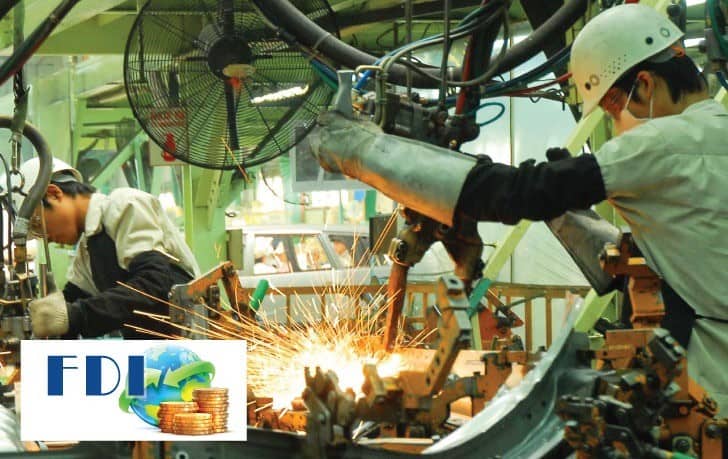
1. Foreign direct investment (FDI) continues to flow strongly into Vietnam, particularly in key sectors.
Specifically, as of April 20, 2018, the whole country had 883 new projects granted investment certificates with a total registered capital of US$3,55 billion, equivalent to 76,1% compared to the same period in 2017. There were 303 projects that registered adjustments to their investment capital, with a total increase of US$2,24 billion, equivalent to 51,5% compared to the same period in 2017.
Also in the first four months of 2018, the whole country recorded 1.863 instances of foreign investors contributing capital and purchasing shares, with a total capital contribution value of US$2,26 billion, an increase of 67% compared to the same period in 2017. Of these, 1.087 instances involved increasing the charter capital of enterprises with a capital contribution value of US$1,56 billion, and 776 instances involved foreign investors acquiring domestic shares, notably without increasing charter capital, with a total capital contribution value of US$703,5 million.
In terms of investment sectors, foreign investors have invested in 17 sectors, with the processing and manufacturing industry attracting the most attention from foreign investors with a total capital of US$4,52 billion, accounting for 56,1% of the total registered investment capital. The real estate business sector ranked second with a total investment of US$807,5 million, accounting for 10% of the total registered investment capital. Third was the wholesale and retail sector with a total registered investment capital of US$779 million, accounting for 9,7% of the total registered investment capital.
In terms of investment partners, 82 countries and territories have investment projects in Vietnam. South Korea ranks first with a total investment of US$2,32 billion, accounting for 28,7% of total investment. Japan ranks second with approximately US$1,29 billion in registered investment, accounting for 16% of total investment. Singapore ranks third with US$808 million in registered investment, accounting for 10% of total investment.
2. Ho Chi Minh City leads in attracting FDI.
According to the Foreign Investment Agency, in the first four months of 2018, foreign investors invested in 53 out of 63 provinces and cities. Ho Chi Minh City remained the locality attracting the most foreign investment with a total registered capital of US$1,92 billion, accounting for 23,8% of the total investment. Hai Phong ranked second with a total registered capital of US$1,03 billion, accounting for 12,8% of the total investment. Hanoi ranked third with a total newly registered capital of US$746 million – accounting for 9,25% of the total investment.
Assessing the continued attraction of FDI into Vietnam in the coming months of 2018, experts believe that the Comprehensive and Progressive Trans-Pacific Partnership (CPTPP) agreement, signed in early March 2018, may bring more optimistic signals. Among the 11 countries that have signed the CPTPP, three are located in Southeast Asia: Vietnam, Singapore, and Malaysia. It is known that Thailand is also interested in joining the organization, and the United States may also rejoin the CPTPP. However, the US has indicated that if it rejoins the organization, it will impose specific conditions, given that it currently accounts for 60% of the GDP of the entire bloc.
One thing is certain: if the US rejoins the CPTPP, Vietnam could be the biggest beneficiary, as Vietnam's textile and garment exports to the US currently hold a very large market share. In particular, Vietnam would benefit even more from the reduction of tariffs under the CPTPP commitments. Therefore, experts believe that in the coming months of 2018, as well as in the years to come, Vietnam needs to be selective in attracting FDI, rather than simply attracting indiscriminately as it has done in the past.
According to the Foreign Investment Agency, in the first four months of 2018, exports from the foreign-invested sector, including crude oil, reached US$53,48 billion, an increase of 18,9% compared to the same period in 2017 and accounting for 72,5% of total export turnover. Exports excluding crude oil reached US$52,81 billion, an increase of 20,3% compared to the same period in 2017 and accounting for 71,6% of total export turnover. Imports by the foreign-invested sector reached US$42,31 billion, an increase of 9,3% compared to the same period in 2017 and accounting for nearly 60,1% of total import turnover. Overall, the foreign-invested sector recorded a trade surplus of US$11,17 billion including crude oil and a trade surplus of US$10,5 billion excluding crude oil…www.expertis.vn