
| THE FINANCIAL | SOCIAL REPUBLIC OF VIETNAM Independence - Freedom - Happiness |
| Number: 99 / 2025 / TT-BTC | Hanoi, date 27 month 10 year 2025 |
APPENDIX III
ACCOUNTING BOOK
(Attached to Circular No. 99/2025/TT-BTC dated July 1, 2025 of the Minister of Finance)
PART A – LIST OF ACCOUNTING BOOK FORMS
(Click on the Symbol number to download the corresponding form) (I.e.
|
No |
Book title |
Symbol |
Accounting methods |
|||
|
General Diary |
Journal – Ledger |
Journal voucher |
Journal – Documents |
|||
|
1 |
2 |
3 |
4 |
5 |
6 |
7 |
|
01 |
Journal – Ledger |
|
x |
|
|
|
|
02 |
Journal voucher |
|
|
x |
|
|
|
03 |
Register of Accounting Vouchers |
|
|
x |
|
|
|
04 |
General Ledger (used for voucher-based accounting) |
|
|
x |
|
|
|
x |
||||||
|
05 |
General Journal |
x |
|
|
|
|
|
06 |
Cash Receipt Log |
x |
|
|
|
|
|
07 |
Cash Disbursement Journal |
x |
|
|
|
|
|
08 |
Purchase Log |
x |
|
|
|
|
|
09 |
Sales Journal |
x |
|
|
|
|
|
10 |
General Ledger (used for general journal format) |
x |
|
|
|
|
|
11 |
Journal – Voucher, types of Journal – Voucher, Statement Including: |
S04-DN |
|
|
|
x |
|
(from S04a1-DN to S04a10-DN) |
|
|
|
x |
|
|
(from S04b1-DN to S04b11-DN) |
|
|
|
x |
|
|
12 |
General Ledger (for journal-voucher format) |
|
|
|
x |
|
|
13 |
Trial balance |
x |
|
x |
|
|
|
14 |
Cash book |
x |
x |
x |
|
|
|
15 |
Cash fund detailed accounting ledger |
x |
x |
x |
|
|
|
16 |
Demand deposit account |
x |
x |
x |
x |
|
|
17 |
Detailed inventory register of materials and tools (products, goods) |
x |
x |
x |
x |
|
|
18 |
Summary table of detailed materials, tools, products, and goods. |
x |
x |
x |
x |
|
|
19 |
Inventory Card (Inventory Ledger) |
x |
x |
x |
x |
|
|
20 |
Fixed Asset Register |
x |
x |
x |
x |
|
|
21 |
Register for tracking fixed assets and tools and equipment at the place of use. |
x |
x |
x |
x |
|
|
22 |
Fixed Asset Card |
x |
x |
x |
x |
|
|
23 |
Detailed payment ledger with buyer (seller) |
x |
x |
x |
x |
|
|
24 |
Detailed ledger of payments with buyers (sellers) in foreign currency. |
x |
x |
x |
x |
|
|
25 |
Foreign currency payment tracking log |
x |
x |
x |
x |
|
|
26 |
Loan details ledger |
x |
x |
x |
x |
|
|
27 |
Sales ledger |
x |
x |
x |
x |
|
|
28 |
Production and business expense ledger |
x |
x |
x |
x |
|
|
29 |
Product and service costing card |
x |
x |
x |
x |
|
|
30 |
Detailed account ledger |
x |
x |
x |
x |
|
|
31 |
Detailed accounting records track investments in joint ventures. |
x |
x |
x |
x |
|
|
32 |
Register for tracking the allocation of differences arising from the purchase of investments in joint ventures. |
x |
x |
x |
x |
|
|
33 |
Detailed accounting records track investments in associate companies. |
x |
x |
x |
x |
|
|
34 |
Register for tracking the allocation of differences arising from the purchase of investments in associate companies. |
x |
x |
x |
x |
|
|
35 |
Share issuance details |
x |
x |
x |
x |
|
|
36 |
Detailed ledger of repurchased shares. |
x |
x |
x |
x |
|
|
37 |
Securities Investment Ledger |
x |
x |
x |
x |
|
|
38 |
Owner's investment tracking ledger |
x |
x |
x |
x |
|
|
39 |
Construction investment cost ledger |
x |
x |
x |
x |
|
|
40 |
VAT tracking log |
x |
x |
x |
x |
|
|
41 |
VAT refund details |
x |
x |
x |
x |
|
|
42 |
Detailed VAT tax return for tax exemptions and reductions. |
x |
x |
x |
x |
|
|
Other detailed ledgers as required by the business management. |
||||||
PART B – FORMS OF ACCOUNTING RECORDS
1. Types of accounting books and forms of accounting books
Accounting records include general ledger and detailed ledger. General ledger includes: Journal and General Ledger. Detailed ledger includes: Detailed accounting books and cards.
a) General ledger
– The Journal is used to record economic and financial transactions arising in each accounting period and in an accounting year in chronological order and the corresponding relationships between the accounts of those transactions. The accounting data in the Journal reflects the total debit and credit entries of all accounting accounts used in the enterprise. The Journal must fully reflect the following contents:
+ Date of entry;
+ The number and date of the accounting document used as the basis for recording entries;
+ Summarize the content of the economic and financial transaction that occurred;
+ The amount of money involved in the economic and financial transaction.
– The General Ledger is used to record economic and financial transactions arising in each period and in an accounting year according to the accounting accounts stipulated in the accounting account system applied to the enterprise. The accounting data in the General Ledger reflects the overall situation of assets, capital sources, and the situation and results of production and business activities of the enterprise. The General Ledger must fully reflect the following contents:
+ Date of entry;
+ The number and date of the accounting document used as the basis for recording entries;
+ Summarize the content of the economic and financial transaction that occurred;
+ The amount of the economic or financial transaction is recorded on the debit or credit side of the account.
b) Detailed accounting ledgers and cards
Detailed accounting ledgers and cards are used to record economic and financial transactions related to accounting objects that require detailed monitoring for management purposes. The data in these ledgers and cards provides information for managing each type of asset, capital, revenue, and expense that is not reflected in the Journal and General Ledger. The number and structure of detailed accounting ledgers and cards are not mandatory. Businesses should base their decisions on the State's guiding regulations regarding detailed accounting ledgers and cards and their own management requirements to open the necessary and appropriate ones.
c) Forms of accounting records
– General Journal accounting method;
– The Journal-Ledger accounting method;
– The accounting method is based on journal entries.
– The journal-voucher accounting method;
– Computerized accounting system.
Each form of accounting ledger has specific regulations regarding the number, structure, format, sequence, recording methods, and relationships between the ledgers.
2. General Journal Accounting Method
a) Basic principles and characteristics of the General Journal accounting system: All economic and financial transactions must be recorded in the journals, primarily the General Journal, in chronological order and according to the economic content (accounting entry) of the transaction. Then, data from the journals is used to record entries in the General Ledger for each transaction. The General Journal accounting system includes the following main types of ledgers:
– General Journal, Special Journal;
– General Ledger;
– Detailed accounting ledgers and cards.
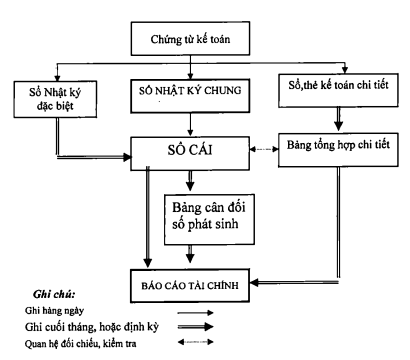
b) Sequence of recording accounting entries using the General Journal accounting method (Diagram 01 below)
– Daily, based on verified documents used as the basis for recording entries, first record the transactions in the General Journal, then use the data recorded in the General Journal to record entries in the Ledger according to the appropriate accounting accounts. If the unit maintains detailed accounting books or cards, simultaneously with recording in the General Journal, the transactions are recorded in the relevant detailed accounting books or cards.
If the unit maintains special journals, daily, based on the supporting documents, the transactions are recorded in the relevant special journal. Periodically (every 3, 5, 10 days) or at the end of the month, depending on the volume of transactions, each special journal is summarized, and the data is used to record entries in the appropriate accounts in the General Ledger, after eliminating any duplicate entries resulting from a single transaction being recorded simultaneously in multiple special journals (if any).
– At the end of the month, quarter, or year, sum the figures in the General Ledger and prepare a Trial Balance. After verification and reconciliation, the figures recorded in the General Ledger and the detailed summary table (compiled from detailed accounting books and cards) are used to prepare the Financial Statements. In principle, the total debits and total credits on the Trial Balance must equal the total debits and total credits on the General Journal (or the General Journal and special journals after eliminating duplicates on the special journals) for the same period.
Form No. 01
ACCOUNTING RECORD-BASED ENTRY PROCEDURE USING THE GENERAL JOURNAL ACCOUNTING METHOD
3. Journal-Ledger Accounting System
a) Basic characteristics of the Journal-Ledger accounting system: Economic and financial transactions are recorded in chronological order and according to their economic content (by accounting account) in a single comprehensive accounting book, the Journal-Ledger. The basis for recording entries in the Journal-Ledger is accounting documents or a summary table of accounting documents of the same type. The Journal-Ledger accounting system includes the following types of accounting books:
– Diary – Ledger;
– Detailed accounting ledgers and cards.
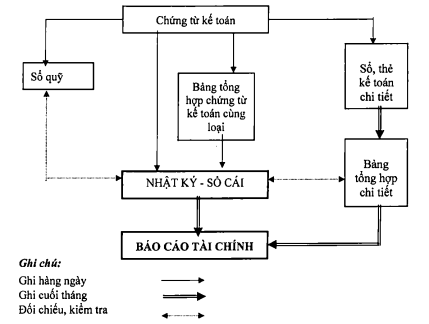
b) Sequence of recording accounting entries using the Journal-Ledger accounting method (Diagram No. 02)
– Daily, based on accounting documents or summary sheets of similar accounting documents that have been checked and used as the basis for recording entries, first determine the debit and credit accounts to record in the Journal – General Ledger. The data of each document (or summary sheet of similar accounting documents) is recorded on one line in both the Journal and the General Ledger sections. The summary sheet of accounting documents is prepared for documents of the same type (receipts, payment vouchers, sales vouchers, purchase vouchers, etc.) that occur multiple times a day or periodically every 1 to 3 days. After being recorded in the Journal – General Ledger, the accounting documents and summary sheets of similar accounting documents are used to record entries in the relevant detailed accounting books and cards.
– At the end of the month, after recording all accounting documents generated during the month in the Journal – General Ledger and other detailed accounting books and cards, the accountant adds up the figures in the transaction column in the Journal and the debit and credit columns of each account in the General Ledger to record in the end-of-month total. Based on the transactions from previous months and the transactions of this month, the cumulative transactions from the beginning of the quarter to the end of this month are calculated. Based on the beginning-of-month (beginning-of-quarter) balance and the transactions during the month, the accountant calculates the ending-of-month (end-of-quarter) balance of each account in the Journal – General Ledger.
– When checking and comparing the end-of-month (end-of-quarter) totals in the Journal – Ledger, the following requirements must be ensured:
|
The total amount in the "Transactions" column of the Journal section. |
= |
Total debit entries for all accounts |
= |
Total credit entries of all accounts |
Total debit balances of accounts = Total credit balances of accounts
– Detailed accounting ledgers and cards must also be closed to sum the debit and credit transactions and calculate the ending balance for each account at the end of the month. Based on the closing figures for each account, a "Detailed Summary Table" is prepared for each account. The figures in the "Detailed Summary Table" are compared with the debit and credit transactions and the ending balance of each account at the Journal and General Ledger. The figures in the Journal and General Ledger and in the "Detailed Summary Table" after closing are checked and compared; if they match, they are used to prepare financial statements.
Form No. 02
ACCOUNTING RECORD-BASED ENTRY PROCEDURE USING THE JOURNAL-LEGENDARY ACCOUNTING SYSTEM
4. Accounting method: Voucher-based accounting
a) Basic characteristics of the voucher-based accounting method: The direct basis for recording entries in the general ledger is the "journal voucher". Recording entries in the general ledger includes:
– Record in chronological order in the Register of Accounting Vouchers.
– Record the economic details in the General Ledger.
Accounting vouchers are prepared by accountants based on individual accounting documents or a summary table of accounting documents of the same type and economic content. Accounting vouchers are numbered consecutively each month or year (according to the serial number in the Accounting Voucher Register) and are accompanied by supporting accounting documents. They must be approved by the chief accountant before being recorded in the accounting books. The accounting system using accounting vouchers includes the following types of accounting books:
+ Accounting vouchers;
+ Register of Accounting Vouchers;
+ General Ledger;
+ Detailed accounting ledgers and cards.
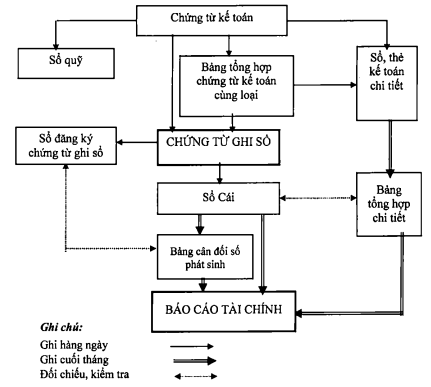
b) Sequence of recording accounting entries using the Voucher-based accounting method (Diagram No. 03)
– Daily, based on verified accounting documents or summaries of similar accounting documents, the accountant prepares journal entries. These journal entries are then recorded in the Journal Entry Register, which is subsequently used to record entries in the General Ledger. After being used as the basis for preparing journal entries, the accounting documents are used to record entries in the relevant detailed accounting ledgers and cards.
– At the end of the month, the books must be closed to calculate the total amount of economic and financial transactions that occurred during the month in the Register of Accounting Vouchers, calculate the total debits, total credits, and the balance of each account in the General Ledger. Based on the General Ledger, prepare the Trial Balance.
– After verification, the figures recorded in the General Ledger and the detailed summary table (compiled from detailed accounting ledgers and cards) are used to prepare the financial statements. The reconciliation and verification process must ensure that the total debits and total credits of all accounts on the Trial Balance are equal and equal to the total amounts recorded in the Journal Register. The total debit balances and total credit balances of the accounts on the Trial Balance must be equal, and the balance of each account on the Trial Balance must equal the balance of the corresponding account on the detailed summary table.
Form No. 03
PROCEDURE FOR RECORDING ACCOUNTING ENTRY USING THE VOUCHER-BASED ACCOUNTING METHOD
5. Journal-Voucher Accounting System
a) Basic characteristics of the Journal-Voucher accounting method
– Gather and systematize economic transactions arising from the credit side of accounts, combined with analyzing those transactions according to their corresponding debit accounts.
– Closely combine the recording of economic transactions in chronological order with the systematization of transactions according to their economic content (by account).
– Widely combine general accounting with detailed accounting on the same accounting books and within the same recording process.
– Use pre-printed forms for recording account relationships, managing economic and financial expenditures, and preparing financial statements.
The Journal-Voucher accounting system includes the following types of accounting books:
+ Journal of vouchers;
+ Inventory list;
+ General Ledger;
+ Detailed accounting ledger or card.
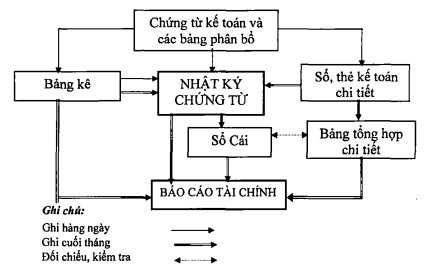
b) Sequence of recording accounting entries using the Journal-Voucher accounting method (Diagram No. 04)
– Daily, based on verified accounting documents, data is directly recorded into the relevant Journals – Vouchers or Statements, and detailed ledgers. For production and business expenses that occur frequently or are of an allocative nature, the original documents are first collected and classified in allocation tables, then the resulting data from the allocation tables is recorded into the relevant Statements and Journals – Vouchers. For Journals – Vouchers recorded based on Statements and detailed ledgers, the total data from the Statements and detailed ledgers is used, and at the end of the month, the data is transferred to the Journals – Vouchers.
– At the end of the month, close the books, sum up the figures in the journals and vouchers, check and compare the figures in the journals and vouchers with the detailed accounting ledgers, cards, and related summary tables, and take the total figures from the journals and vouchers to record directly in the General Ledger. For vouchers related to detailed accounting ledgers and cards, they are recorded directly in the relevant ledgers and cards. At the end of the month, sum up the detailed accounting ledgers or cards and, based on the detailed accounting ledgers or cards, prepare detailed summary tables for each account to compare with the General Ledger. The total figures in the General Ledger and some detailed indicators in the journals and vouchers, statements, and detailed summary tables are used to prepare financial statements.
Form No. 04
ACCOUNTING RECORD-BASED ENTRY PROCEDURE USING THE JOURNAL-VOUCHER ACCOUNTING METHOD
6. Computerized accounting
a) Basic characteristics of computerized accounting: Accounting work is performed using accounting software on a computer. The accounting software is designed according to the principles of one of the four accounting methods or a combination of the methods specified above. The accounting software does not display the complete accounting record-keeping process, but it must be able to print all accounting ledgers and financial reports as required. The accounting software designed according to a particular accounting method will have the types of ledgers for that method, but they will not be exactly the same as the handwritten ledgers.
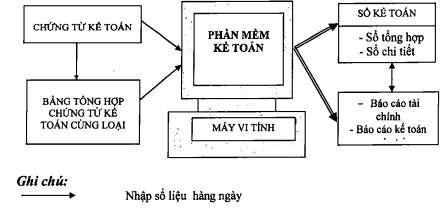
b) Sequence of recording accounting entries using the computerized accounting system (Form No. 05)
– Daily, accountants use verified accounting documents or summaries of similar documents as the basis for recording entries, determining debit and credit accounts to input data into the computer using pre-designed tables and forms in the accounting software. Following the accounting software's process, the information is automatically entered into the general ledger (General Ledger or Journal-General Ledger…) and related detailed accounting ledgers and cards.
– At the end of the month (or at any time necessary), the accountant performs the closing of the books (summation) and prepares financial statements. The reconciliation between the summarized figures and the detailed figures is performed automatically and always ensures accuracy and integrity based on the information entered during the period. The accountant can check and reconcile the figures between the accounting books and the financial statements after they have been printed. At the end of the month and the end of the year, the summary and detailed accounting books are printed on paper, bound into books, and the necessary legal procedures are followed.
Form No. 05
PROCEDURE FOR RECORDING ACCOUNTING BOOKS USING COMPUTERIZED ACCOUNTING

PART C – EXPLANATION OF CONTENT AND METHODS OF ACCOUNTING RECORDING
I. Explanation of the content and methods of recording in the general ledger.
1. Content, structure, and recording methods in the Journal-Ledger format:
In the journal-ledger accounting system, there is only one general ledger book: the Journal-Ledger (Form No. S01-DN).
(Click to view detailed instructions) ↓
Journal - Ledger (Form No. S01-DN)
a) Content:
– The Journal – General Ledger is the only comprehensive accounting book used to reflect all economic transactions that occur in chronological order and systematized according to their economic content (by accounting account).
– The data recorded in the Journal and Ledger are used to prepare financial statements.
b) Structure and method of record keeping:
Structure:
The Journal-Ledger is a comprehensive accounting record consisting of two parts: the Journal and the Ledger.
The Journal section includes the following columns: "Date of entry", "Voucher number", "Date of the document", "Description" of the transaction, and "Amount". The Journal section is used to record economic transactions in chronological order.
General Ledger Section: This section has multiple columns, with each account recorded in two columns: Debit and Credit. The number of columns depends on the number of accounts used in the accounting unit. The General Ledger section is used to reflect economic transactions according to their economic content (by accounting account).
+ Bookkeeping method:
– Daily record keeping:
Every day, upon receiving accounting documents, the person maintaining the Journal and Ledger must verify their legal validity. Based on the transaction details recorded on the document, they determine the debit and credit accounts. For accounting documents of the same type, the accountant prepares a "Summary Table of Accounting Documents of the Same Type." Then, they record the necessary information from the accounting document or the "Summary Table of Accounting Documents of the Same Type" in the Journal and Ledger.
Each accounting document or "Summary of similar accounting documents" is recorded in the Journal - General Ledger on a single line, simultaneously in both the Journal and General Ledger sections. First, in the Journal section, record entries in the following columns: "Date of entry," "Document number," "Date," and "Description" of the economic transaction. Based on the amount recorded on the document, record the amount in the "Amount" column. Then, record the amount of the economic transaction in the Debit and Credit columns of the relevant accounts in the General Ledger section, specifically:
– Columns F and G: Record the corresponding account numbers for the economic transaction;
– Column H: Record the serial number of the transaction in the Journal – Ledger;
– From column 2 onwards: Record the amount generated for each account according to the corresponding accounting entries already recorded in columns F and G.
At the end of the month, the amounts recorded in the journal entries and debit and credit entries must be totaled to calculate the balance. The cumulative balances from the beginning of the quarter for each account are then added together to form the basis for preparing the financial statements.
2. Content, structure, and recording methods using the voucher-based accounting system.
Register of Accounting Vouchers (Form No. S02b-DN)
a) Content:
The Journal Register is a general accounting ledger used to record economic transactions in chronological order (Journal). This ledger is used both to register economic transactions and manage accounting vouchers, as well as to verify and reconcile data with the Trial Balance.
b) Structure and recording methods:
Column A: Record the number of the journal entry.
Column B: Record the date the journal entry was created.
Column 1: Record the amount of the Journal Voucher.
At the end of the ledger page, the cumulative total must be added up to carry over to the next page.
At the top of the ledger page, the total from the previous page should be recorded.
At the end of the month and the end of the year, the accountant totals the amounts recorded in the Journal Entry Register and compares the figures with the Trial Balance.
General Ledger (Forms S02c1-DN and S02c2-DN)
a) Content:
The General Ledger is a comprehensive accounting book used to record economic transactions according to the accounting accounts stipulated in the accounting account system applied to the enterprise.
The figures recorded in the General Ledger are used to verify and compare with the figures recorded in the detailed summary tables or detailed accounting ledgers (cards) and are used to prepare the Trial Balance and Financial Statements.
b) Structure and method of recording in the General Ledger:
In the voucher-based accounting system, the General Ledger is opened separately for each account. Each account has one or more pages depending on the number of economic transactions recorded for that account.
There are two types of ledgers: ledgers with few columns and ledgers with many columns.
+ Ledger with few columns: This is typically applied to accounts with few or simple economic transactions.
+ Ledger with multiple columns: This is often applied to accounts with many economic transactions, or complex economic transactions that require detailed tracking. These transactions can be combined into a separate page in the General Ledger and analyzed in detail according to the corresponding account.
Structure of the Ledger with few columns (Form No. S02c1-DN)
– Column A: Record the date of entry.
– Columns B and C: Record the number, date, and month of the journal entry.
– Column D: Briefly record the details of the economic transaction that occurred.
– Column E: Record the corresponding account number.
– Columns 1 and 2: Record the debit and credit amounts for this account.
Structure of the Multi-Column Ledger (Form No. S02c2-DN)
– Column A: Record the date of entry.
– Columns B and C: Record the number, date, and month of the journal entry.
– Column D: Briefly record the details of the economic transaction that occurred.
– Column E: Record the corresponding account number.
– Columns 1 and 2: Record the total debit and credit amounts for this account.
– Columns 3 to 10: Record the debit and credit amounts of the level 2 accounts.
* Method of recording in the General Ledger:
– Based on the journal voucher, entries are made in the Journal Voucher Register, and then the journal voucher is used to record entries in the General Ledger and related detailed accounting books and cards.
– Daily, based on the journal vouchers, record entries in the General Ledger in the appropriate columns.
– At the end of each page, you must total the amount in each column and transfer it to the beginning of the next page.
– At the end of the month (quarter, year), the accountant must close the books, add up the debit and credit entries, calculate the balance, and add up the cumulative entries from the beginning of the quarter or year for each account to serve as the basis for preparing the Trial Balance and Financial Statements.
3. Content, structure, and method of recording entries in the form of a general journal:
(1) General logbook (Form No. 03a-DN)
a) Content:
The General Journal is a comprehensive accounting book used to record economic and financial transactions in chronological order, reflecting the corresponding account relationships (accounting entries) to facilitate entries in the General Ledger. The data recorded in the General Journal serves as the basis for entries in the General Ledger.
b) Structure and method of record keeping:
The structure of the general journal is standardized according to the mẫu (template) issued in this system:
– Column A: Record the date of entry.
– Columns B and C: Record the number and date of creation of the accounting document used as the basis for recording in the ledger.
– Column D: Summarize the economic and financial transactions arising from the accounting document.
– Column E: Marks the transactions recorded in the General Journal that have been transferred to the Ledger.
– Column G: Record the line number of the General Journal
– Column H: Record the account numbers for debit and credit entries according to the accounting entries for the transactions. Debit accounts are recorded first, followed by credit accounts, with each account on a separate line.
– Column 1: Record the amount generated in the Debit Accounts.
– Column 2: Record the amount generated in the Credit Accounts.
At the bottom of the ledger page, add up the cumulative total to carry over to the next page. At the top of the ledger page, record the total from the previous page.
In principle, all economic and financial transactions must be recorded in the general journal. However, in cases where one or more accounting objects have a large number of transactions, to simplify and reduce the volume of entries in the general ledger, the enterprise may open special journals to record the transactions related to those accounting objects separately.
Special journals are part of the general journal, so the recording method is similar to that of the general journal. However, to avoid duplication, transactions already recorded in the special journals are not recorded in the general journal. In this case, the basis for recording in the ledger is the general journal and the special journals.
Below are guidelines on the content, structure, and recording methods of some common special journals.
(1.1) Cash Collection Log (Form No. 03a1-DN)
a) Content: This is a special journal used to record the cash receipts of a business. This journal is opened separately for cash receipts, bank transfers, for each currency (Vietnamese Dong, foreign currency), or for each place of receipt (Bank A, Bank B, etc.).
b) Structure and method of record keeping:
– Column A: Record the date of entry.
– Columns B and C: Record the number and date of creation of the accounting document used as the basis for recording in the ledger.
– Column D: Summarize the economic transaction details of the accounting document.
– Column 1: Record the amount received on the debit side of the cash account tracked in this ledger, such as: Cash, demand deposits, etc.
– Columns 2, 3, 4, 5, 6: Record the credit amounts generated in the corresponding accounts.
At the end of the ledger page, add up the cumulative total to carry over to the next page.
At the top of the ledger page, record the total from the previous page carried over.
(1.2) Cash disbursement log (Form No. S03a2-DN)
a) Content: This is a special journal used to record cash disbursement transactions of the business. This journal is opened separately for cash disbursements, bank disbursements, for each type of currency (Vietnamese Dong, foreign currency) or for each disbursement location (Bank A, Bank B, etc.).
b) Structure and method of record keeping:
– Column A: Record the date of entry.
– Columns B and C: Record the document number and the date of creation used as the basis for recording in the ledger.
– Column D: Briefly record the content of the accounting transaction.
– Column 1: Record the amount disbursed to the credit side of the cash account tracked in this ledger, such as: Cash, demand deposits, etc.
– Columns 2, 3, 4, 5, 6: Record the debit amounts of the corresponding accounts.
At the bottom of the ledger page, add up the cumulative total to carry over to the next page. At the top of the ledger page, record the total from the previous page.
(1.3) Purchase log (Form No. S03a3-DN)
a) Content: This is a special journal used to record purchasing transactions for each type of inventory held by the unit, such as: raw materials; tools; goods; etc.
The Purchase Journal is used to record purchase transactions made on credit (pay later). If payment is made in advance to the seller, the purchase transaction should also be recorded in this journal.
b) Structure and method of bookkeeping.
– Column A: Record the date of entry.
– Columns B and C: Record the number and date of creation of the accounting document used as the basis for recording in the ledger.
– Column D: Briefly record the content of the accounting transaction.
– Columns 1, 2, 3: Debit inventory accounts such as: Goods, raw materials, tools, equipment, etc. If the unit maintains this ledger for each type of inventory, these columns can be used to record details for that type of inventory, such as: Goods A, Goods B, etc.
– Column 4: Record the amount payable to the seller corresponding to the goods purchased.
At the bottom of the ledger page, add up the cumulative total to carry over to the next page. At the top of the ledger page, record the total from the previous page that was carried over.
(1.4) Sales log (Form No. S03a4-DN)
a) Content: This is a special journal used to record the sales transactions of a business, such as the sale of goods, products, and services.
The Sales Journal is used to record sales transactions where payment is collected later (credit sales). If the buyer pays in advance, the sales transaction is also recorded in this journal.
b) Structure and method of recording entries:
– Column A: Record the date of entry.
– Columns B and C: Record the document number and the date of creation used as the basis for recording in the ledger.
– Column D: Briefly record the content of the accounting transaction.
– Column 1: Record the amount receivable from the buyer based on sales revenue.
– Columns 2, 3, and 4: Open as required by the business to record revenue by type of transaction: Sale of goods, sale of products, sale of investment properties, provision of services, etc. If the business opens this ledger for each type of revenue: Sale of goods, sale of products, sale of investment properties, provision of services, etc., then these columns can be used to record details for each type of goods, products, investment properties, and services. If not necessary, the business can combine these three columns into one column to record general sales revenue.
At the bottom of the ledger page, add up the cumulative total to carry over to the next page. At the top of the ledger page, record the total from the previous page that was carried over.
Businesses may open one or more special journals as described above for recording purposes. If additional special journals need to be opened, the established rules for opening and recording entries must be followed.
(2) General Ledger (Form No. S03b-DN)
a) Content: The General Ledger is a comprehensive accounting book used to record economic and financial transactions arising during an accounting period according to the accounting accounts stipulated in the accounting chart of accounts applied to the enterprise. Each account is opened on one or more consecutive pages in the General Ledger, sufficient to record transactions for an accounting period.
b) Structure and method of record keeping:
The General Ledger is standardized according to the form issued under this regime.
The method for recording entries in the General Ledger is as follows:
– Column A: Record the date of entry.
– Columns B and C: Record the number and date of creation of the accounting document used as the basis for recording in the ledger.
– Column D: Briefly record the details of the transaction that occurred.
– Column E: Record the page number of the General Journal that recorded this transaction.
– Column G: Record the line number of the General Journal that recorded this transaction.
– Column H: Record the account numbers of the corresponding accounts related to the transactions arising from this General Ledger account (Debit accounts first, Credit accounts second).
– Columns 1 and 2: Record the debit or credit amount of the account for each economic transaction.
At the beginning of the month, record the opening balance of each account in the first line, in the balance column (Debit or Credit). At the end of the month, add up the debit and credit transactions to calculate the balance and add up the cumulative transactions from the beginning of the quarter for each account to use as the basis for preparing the Trial Balance and financial statements.
4. Content, structure, and recording methods in the Journal-Voucher format.
(1) Voucher log
In the Journal-Voucher format, there are 10 Journal-Vouchers, numbered from Journal-Voucher No. 1 to Journal-Voucher No. 10.
The journal of vouchers is a general accounting book used to reflect all economic and financial transactions arising from the credit side of accounts. A journal of vouchers can be opened for one account or for several accounts with similar economic content or closely related to each other. When a journal of vouchers is opened for multiple accounts, the transactions of each account are reflected separately in several lines or columns dedicated to each account. In all cases, the credit transactions of each account are reflected in only one journal of vouchers and are recorded in the General Ledger once at the end of the month. The debit transactions of each account are reflected in different journals of vouchers, crediting related accounts that are debited to that account, and at the end of the month, these journals of vouchers are aggregated into the General Ledger.
To facilitate analysis and verification, in addition to the main section reflecting credit transactions, some journal entries include columns reflecting debit transactions, beginning balances, and ending balances of accounts. The data in these debit transaction columns is for verification and analysis purposes only and is not used for recording in the General Ledger.
The basis for recording journal entries is the original documents, data from detailed accounting ledgers, and statements and allocation tables.
The journal entry must be opened monthly. At the end of each month, the old journal entry must be closed and a new one opened for the following month. Each time the old journal entry is closed and a new one opened, the entire necessary balance must be transferred from the old journal entry to the new one, depending on the specific requirements of each account.
Basic content and recording sequence of personal records.
(Click to view detailed instructions) ↓
(1.1) Journal - Voucher No. 1 (Form No. S04a1-DN)
Used to reflect the credit entries in account 111 "Cash" (expenditure portion) offsetting the debit entries in related accounts.
– Structure and method of bookkeeping:
Journal Entry No. 1 includes columns for the serial number and date of the journal entry, columns reflecting the credit entries of Account 111 "Cash" offsetting debits with related accounts, and a column for the total credit entry of Account 111. The basis for recording Journal Entry No. 1 (crediting Account 111) is the cash report accompanied by original documents (payment vouchers, invoices, etc.). Each cash report is recorded on a separate line in Journal Entry No. 1 in chronological order.
At the end of the month or quarter, close Journal Entry No. 1, determine the total amount of credit entries in Account 111 offsetting the debit entries of related accounts, and use the total from Journal Entry No. 1 to record in the General Ledger (Credit Account 111, Debit accounts).
(1.2) Journal - Voucher No. 2 (Form No. S04a2-DN)
This entry is used to reflect the credit entries in Account 112 "Demand Deposits" offsetting the debit entries in related accounts. The structure and method of recording are as follows: Entry No. 2 includes columns for the serial number, document number, date of the journal entry, explanation of the transaction, columns reflecting the credit entries in Account 112 offsetting the debit entries in related accounts, and a column for the total credit entries in Account 112. The basis for recording Entry No. 2 is the bank's debit notices accompanied by related original documents.
At the end of the month or quarter, close journal entry number 2, determine the total amount of credit entries in account 112 offsetting the debit entries of related accounts, and use the total from journal entry number 2 to record in the General Ledger (Credit account 112, Debit accounts).
(1.3) Journal - Voucher No. 3 (Form No. S04a3-DN)
Used to reflect the credit entries in Account 113 “Cash in Transit” offsetting the debits in related accounts. Structure and recording method: Journal Entry No. 3 includes columns for the serial number, document number, date of the journal entry, explanation of the transaction, columns reflecting the credit entries in Account 113 offsetting the debits in related accounts, and a column for totaling the credit entries in Account 113. Basis for recording in Journal Entry No. 3:
+ At the beginning of the month, when opening journal entry number 3, you must base the entry on journal entry number 3 from the previous month to record the opening balance in account 113.
+ The entry for Account 113 should be based on the bank's credit notification.
At the end of the month or quarter, close journal entry number 3, determine the total credit balance of account 113 offsetting the debit balances of related accounts, and use the total from journal entry number 3 to record in the General Ledger (Credit account 113, Debit related accounts).
(1.4) Journal - Voucher No. 4 (Form No. S04a4-DN)
Used to reflect the credit entries in accounts 341 "Loans and financial lease liabilities" and 343 "Issued bonds" offsetting the debit entries of related accounts.
In addition to the credit entries to accounts 341 and 343 offsetting the debits to related accounts, journal entry number 4 also includes a payment tracking section (debit entries to accounts 341 and 343 offsetting the credit entries to related accounts). The structure and method of recording entries are as follows:
Journal Entry Form No. 4 includes columns for the serial number, document number, and date of the journal entry, a description of the transaction, and columns reflecting the credit and debit entries of accounts 341 and 343, corresponding to the debit and credit entries of related accounts.
When opening Account Number 4, the transaction amounts for each loan account, short-term and long-term debt, are reflected separately on several pages dedicated to each account.
The basis for recording in Journal Entry No. 4 is the loan agreement, economic contract (lease-purchase of fixed assets, long-term debts), debit and credit notices from the bank, and other related documents concerning short-term and long-term loans and debts.
At the end of the month or quarter, close the NKCT No. 4 ledger, determine the total credit entries of each account 341 and 343 corresponding to the debit entries of the related accounts.
The total figures from Journal Entry No. 4 are used to record the General Ledger for Accounts 341 and 343 (Credit Account 341, Debit various accounts; Credit Account 343, Debit various accounts).
(1.5) Journal - Voucher No. 5 (Form No. S04a5-DN)
Used to summarize the payment and debt situation with suppliers of materials, goods, and services to the business (Account 331 "Accounts payable to suppliers").
Journal Entry No. 5 consists of two parts: the part reflecting the credit entries in Account 331 offsetting the debits in related accounts, and the part tracking payments (debit entries in Account 331 offsetting the credits in related accounts). Structure and method of recording:
NKCT No. 5 includes columns for serial number, unit name (or seller), beginning balance, columns reflecting the credit entries of account 331 offsetting debits with related accounts, and columns reflecting the debit entries of account 331 offsetting credits with related accounts.
The basis for recording in Journal Entry No. 5 is the payment tracking ledger (Account 331 "Accounts Payable to Suppliers"). At the end of each month, after completing the detailed recording of Account 331, the accountant takes the total figures at the end of the month from each detailed ledger opened for each entity and records them in Journal Entry No. 5 (The total figures from each detailed ledger are recorded in Journal Entry No. 5 on a single line).
At the end of the month, close journal entry number 5, determine the total amount of credit entries in account 331 offsetting the debit entries in related accounts, and use the total figures from journal entry number 5 to record in the General Ledger (Credit account 331, Debit accounts).
(1.6) Journal - Voucher No. 6 (Form No. S04a6-DN)
Used to reflect the credit entries in Account 151 "Goods in Transit" to track the status of purchased materials, tools, and goods that are still in transit. Structure and recording method:
NKCT No. 6 includes columns for serial number, description of the transaction being recorded, document number and date used for recording, columns reflecting the credit entries of account 151 offsetting debit entries with related accounts, and columns for the beginning and ending balances of the month.
The basis for recording entry number 6 is the seller's invoice and the warehouse receipt. The principle for recording this entry is to record it according to each invoice and warehouse receipt for materials and goods.
For all invoices for purchased materials and goods that have been paid for or accepted for payment, but have not arrived by the end of the month, record the "Beginning Balance" column of Inventory Receipt No. 6 for the following month (one line per invoice). In the following month, when the goods arrive, record the quantity of goods received in the appropriate columns under "Credit Account 151, Debit Accounts" based on the warehouse receipt.
At the end of the month or quarter, close journal entry number 6, determine the total amount of credit entries to account 151 offsetting the debit entries of related accounts, and use the total from journal entry number 6 to record in the General Ledger (Credit account 151, Debit accounts).
(1.7) Journal - Voucher No. 7 (Form No. S04a7-DN)
Used to summarize all production and business costs of the enterprise and to reflect the credit entries in accounts related to production and business costs, including accounts 152, 153, 154, 214, 241, 242, 334, 335, 338, 352, 621, 622, 623, 627 and some accounts already reflected in other journals/vouchers, but related to production and business costs incurred during the period, and used to debit accounts 154, 621, 622, 623, 627, 242, 2413, 335, 641, 642…
NKCT No. 7 consists of 3 parts:
– Part I: This is the aggregation of production and business costs for the entire enterprise, reflecting all credit entries in accounts related to production and business expenses.
– Part II: Production costs by element.
– Part III: Internal transfers are not included in production or business costs.
Method of recording in the Journal – Document No. 7:
Part I
Part I. This section compiles the total production and business costs of the entire enterprise, reflecting all credit entries in accounts related to production and business expenses. The basis for recording this section is:
– Based on the debit entries of accounts 154, 621, 622, 623, and 627 in Statement No. 4, determine the total debit amount for each account 154, 621, 622, 623, and 627 and record it in the appropriate columns and rows of this section.
– Take the data from Statement No. 5, specifically the debit entries for accounts 2413, 641, and 642, and record them in the relevant lines.
– Take the data from Statement No. 6, the debit entries of accounts 242 and 335, 352, and 356, and record them in the debit lines of account 242 and account 335, account 352, and account 356 in this section.
– Based on the Allocation Tables, Journals – Vouchers, and related documents, record the information in the appropriate lines in Section B, Part I of Journal – Voucher No. 7.
– The total figures from Part I are used for recording in the General Ledger.
Part II
Part II. Production costs, by element: According to current regulations, the production and business costs of an enterprise consist of 5 cost elements:
– Costs of raw materials and supplies;
– Labor costs;
– Depreciation costs of fixed assets;
– Costs of outsourced services;
– Other expenses paid in cash.
How to Prepare Part II of NKCT No. 7
1. Raw materials and supplies:
Based on the credit entries of accounts 152 and 153, corresponding to the debit entries of the accounts listed in Section A, Part I of Journal - Voucher No. 7, record the transactions in the appropriate lines of this section.
Based on the relevant documents and accounting records, determine the portion of raw materials purchased externally that are not entered into inventory and are immediately used, and record this in the appropriate lines of Part II of Journal - Voucher No. 7 under the "Materials and Supplies" category.
When calculating the cost of raw materials and supplies, it is necessary to exclude unused raw materials, supplies, and fuel that are returned to the warehouse, as well as recovered scrap materials.
2. Labor cost factor:
Based on the credit entries in account 334 and account 338 (3382, 3383, 3384, etc.) offsetting the debit entries in Section A, Part I of Journal - Voucher No. 7, record the labor cost element in the appropriate lines of Part II of Journal - Voucher No. 7.
3. Depreciation factors for fixed assets:
Based on the credit entries in Account 214 offsetting the debit entries in Section A, Part I of Journal Entry No. 7, record the depreciation of fixed assets in the appropriate lines of Part II of Journal Entry No. 7.
4. Cost factors of outsourced services:
Based on the relevant Statements, Detailed Ledgers, and Journal - Voucher No. 1, 2, 5,… determine the portion of outsourced service costs to record in column 4 (appropriate lines) in Part II of Journal - Voucher No. 7.
5. Other monetary cost factors:
Based on the relevant Statements, Detailed Ledgers, and Journal - Voucher No. 1, 2, 5,… determine the other expenses in cash to record in column 5 (appropriate lines) on Part II of Journal - Voucher No. 7.
Part III
Vegetable section. Internal transfers are not included in production or business costs.
Instructions for completing Part III of NKCT No. 7:
– Based on the credit entries in account 154 offsetting the debit entries in related accounts (154, 242, 2413, 335, 621, 627, 641, 642,…) in Section A, Part I of Journal – Voucher No. 7, record the entries in column 1 of the lines for accounts 154, 242, 2413, 335, 621, 623, 627, 641, 642, 632 accordingly in Part III of Journal – Voucher No. 7.
– Based on the credit entry of account 621 offsetting the debit entry of account 154 in Section A, Part I of Journal Entry - Voucher No. 7, record it in column 2 of line account 154 in Part III of Journal Entry No. 7.
– Based on the credit entry of account 622 offsetting the debit entry of account 154 in Section A, Part I of Journal Entry - Voucher No. 7, record the transaction in column 3 of account 154 in Part III of Journal Entry No. 7.
– Based on the credit entry of account 623 offsetting the debit entry of account 154 in Section A, Part I of Journal Entry - Voucher No. 7, record the transaction in column 4 of account 154 in Part III of Journal Entry No. 7.
– Based on the credit entry of account 627 offsetting the debit entry of account 154 in Section A, Part I of Journal Entry - Voucher No. 7, record the transaction in column 5 of account 154 in Part III of Journal Entry No. 7.
– Based on the credit entries of accounts 242, 335, 2413, and 352 corresponding to the debit entries of accounts 154, 621, 623, 627, 641, and 642 in Section A, Part I of Journal Entry No. 7, record the entries in columns 6, 7, 8, and 9 of accounts 154, 621, 622, 623, 627, 641, and 642 accordingly in Part III of Journal Entry No. 7.
(1.8) Journal - Voucher No. 8 (Form No. S04a8-DN)
Used to reflect the credit entries in accounts 155, 156, 157, 158, 131, 511, 515, 632, 635, 641, 642, 711, 811, 821, and 911. Structure and recording method:
Journal Entry No. 8 consists of columns for serial numbers, debit account numbers, and columns reflecting the credit entries of accounts 155, 156, 157, 158, 131, 511, 515, 632, 635, 641, 642, 711, 811, 821, 911. Horizontal rows reflect the debit entries of accounts related to the credit entries in the vertical columns. Basis and method for recording in Journal Entry No. 8:
– Based on Statement No. 8 and Statement No. 10, in the Credit section, record the entries in the Credit columns of Accounts 155, 156, 157, and 158.
– Based on Statement No. 11, the credit entry should be recorded in the credit column of Account 131.
– Based on the sales ledger used for account 511, the credit entries should be recorded in the credit columns of account 511.
– Based on the detailed ledger used for accounts 515, 632, 635, 641, 642, 711, 811, 821, 911, the credit entries should be recorded in the credit columns of accounts 515, 632, 635, 641, 642, 711, 811, 821, 911.
At the end of the month or quarter, close journal entry number 8 to determine the total credit entries of accounts 155, 156, 157, 158, 131, 511, 515, 632, 641, 642, 711, 811, 821, 911 offsetting the debit entries of related accounts, and use the total from journal entry number 8 to record in the General Ledger.
(1.9) Journal - Voucher No. 9 (Form No. S04a9-DN)
Used to reflect the credit entries in Account 211 “Tangible Fixed Assets”, Account 212 “Fixed Assets under Financial Lease”, Account 213 “Intangible Fixed Assets”, Account 215 – Biological Assets, and Account 217 “Investment Properties”. Structure and recording method:
NKCT No. 9 includes columns for the serial number, document number, and date of the document used for recording, a description of the transaction being recorded, and columns reflecting the credit entries of accounts 211, 212, 213, 215, and 217 offsetting the debit entries of related accounts.
The basis for recording entry number 9 is the minutes of handover, sale, and liquidation of fixed assets and other documents related to the reduction of fixed assets of the enterprise.
At the end of the month or quarter, close journal entry number 9, determine the credit entries in accounts 211, 212, 213, 215, and 217 corresponding to the debit entries of the related accounts, and use the total from journal entry number 9 to record in the General Ledger.
(1.10) Journal - Voucher No. 10 (Form No. S04a10-DN)
Used to reflect the credit entries of accounts 121, 128, 136, 138, 141, 171, 221, 222, 228, 229, 243, 244, 333, 336, 337, 338, 344, 347, 353, 411, 412, 413, 414, 418, 419, 421. Each account is recorded on a separate Journal Voucher sheet.
– Structure and method of recording: Journal Entry No. 10 includes columns for serial number, explanation of the transaction content, columns reflecting the credit and debit entries of accounts 121, 128, 136, 138, 141, 171, 221, 222, 228, 229, 243, 244, 333, 336, 337, 338, 344, 347, 353, 411, 412, 413, 414, 418, 419, 421 corresponding debit and credit entries with related accounts, and columns for beginning and ending balances. Basis for recording Journal Entry No. 10:
Based on the detailed securities investment ledger used for accounts 121 and 221, the credit entries should be recorded in the credit columns for accounts 121 and 221, and the debit entries for related accounts should be recorded in the appropriate columns.
– Based on the payment tracking ledger for accounts 136, 138, 141, 222, 244, 333, 336, 344, record the credit entries in the appropriate columns for the credit entries of accounts 136, 138, 141, 222, 244, 333, 336, 344, and debit the relevant accounts in the appropriate columns.
– Based on the detailed ledger used for accounts 128, 228, 229, 171, 353, 411, 412, 413, 414, 418, 421, the credit entries should be recorded in the credit columns of accounts 128, 228, 229, 171, 353, 411, 412, 413, 414, 418, 421.
At the end of the month or quarter, close journal entry number 10, determine the credit entries for accounts 121, 128, 136, 138, 141, 171, 221, 222, 228, 229, 243, 244, 333, 336, 338, 344, 347, 353, 411, 412, 413, 414, 418, 419, 421, and use the total from journal entry number 10 to record in the General Ledger.
(2) Statement
In the NKCT format, there are 10 lists numbered sequentially from List No. 1 to List No. 11. (There is no item number 7)A summary sheet is used when the detailed accounting indicators of several accounts cannot be directly reflected in the journal entries. When using a summary sheet, the data from the original documents is first recorded in the summary sheet. At the end of the month, the total figures from all the summary sheets are transferred to the relevant journal entries.
The statement can be opened according to the credit or debit side of the accounts, and can combine to reflect the beginning balance, debit and credit transactions during the month, and the ending balance... serving the purpose of checking, reconciling data, and transferring ledgers at the end of the month. The data from the statement is not used to record in the General Ledger.
Structure and recording methods of the inventory lists:
(Click to view detailed instructions) ↓
(2.1) Statement No. 1 (Form No. S04b1-DN)
Used to reflect debit entries in Account 111 "Cash" (Receipts) offsetting credit entries in related accounts. Structure and recording method:
Statement No. 1 includes columns for the serial number, document number, date, and month of the journal entry, a description of the transaction, columns reflecting the debit entries of account 111 offsetting the credit entries with related accounts, and a column for the ending balance.
The basis for filling out Statement No. 1 is the Receipt Vouchers accompanied by the relevant original documents.
At the beginning of the month, when opening Statement No. 1, the closing balance of Account 111 from the previous month is used to record the opening balance for this month. The closing balance for the day is calculated by adding (+) the debit transactions of the day on Statement No. 1 and subtracting (-) the credit transactions of the day on Journal Entry No. 1. This balance must match the cash balance available in the fund at the end of the day.
At the end of the month or quarter, close the books using Statement No. 1, determining the total debit balance of Account 111 and the corresponding credit balance of the related accounts.
(2.2) Statement No. 2 (Form No. S04b2-DN)
Used to reflect debit entries in account 112 "Demand Deposits" offsetting credit entries in related accounts. Structure and recording method:
Statement No. 2 includes columns for the serial number, document number, date of the journal entry, explanation of the transaction, columns reflecting the debit entries of account 112 offsetting the credit entries with related accounts, and a column for the ending balance.
The basis for recording Statement No. 2 is the bank's credit advice accompanied by relevant original documents. The method for calculating the beginning-of-month, end-of-month, and end-of-day balances of Account 112 on Statement No. 2 is similar to the method for calculating the balance of Account 111 on Statement No. 1.
At the end of the month or quarter, close the books using Statement No. 2, determining the total debit balance of Account 112 and the corresponding credit balances of related accounts.
(2.3) Statement No. 3 (Form No. S04b3-DN)
Used to calculate the actual cost of raw materials, supplies, and tools and equipment. Statement No. 3 is only used in businesses that use accounting prices in detailed material accounting. The method for preparing Statement No. 3 must be based on:
+ In journal entry number 5, the entry should be Credit Account 331, Debit Accounts 152 and 153.
+ In journal entry number 6, the entry should be Credit Account 151, Debit Accounts 152 and 153.
+ In journal entry number 2, the entry should be Credit Account 112, Debit Accounts 152 and 153.
+ In journal entry number 1, the entry should be Credit Account 111, Debit Accounts 152 and 153.
+ NKCT No. 7…
Statement No. 3 includes a summary of the value of raw materials and supplies received into inventory, and the difference between the actual price and the accounting price.
The price difference coefficient for raw materials and supplies is determined by the following formula:
|
Price difference coefficient |
= |
Actual cost of beginning inventory |
+ |
Actual cost of materials received into inventory during the period |
| ———————————————————————————————————————— | ||||
|
The accounting price of beginning inventory materials. |
+ |
The accounting price of materials received into inventory during the period. |
||
The value of raw materials and supplies issued for use during the month will be determined by (=) the value of raw materials and supplies issued from inventory at accounting price (in Allocation Table No. 2 – Allocation Table of Raw Materials, Supplies and Tools) multiplied (x) by the difference coefficient on Statement No. 3.
(2.4) Statement No. 4 (Form No. S04b4-DN)
Used to summarize the credit entries of accounts 152, 153, 154, 214, 241, 242, 334, 335, 338, 352, 621, 622, 623, 627 offsetting the debit entries of accounts 154, 621, 622, 623, 627, and is aggregated by workshop, production department, and detailed for each product and service. Structure and method of recording:
Statement No. 4 includes columns for serial numbers, columns reflecting the credit entries of accounts 152, 153, 154, 214, 241, 242, 334, 335, 338, 352, 621, 622, 623, 627, and horizontal rows reflecting direct production costs (debit accounts 154, 621, 622, 623, 627) offsetting the credit entries with related accounts reflected in the vertical columns.
The basis for recording in Statement No. 4 is based on Allocation Tables No. 1, No. 2, No. 3, and related statements and journal entries, to fill in the appropriate columns and rows of Statement No. 4. The aggregated data from Statement No. 4, after closing the books at the end of the month or quarter, is used to record in Journal Entry No. 7.
(2.5) Statement No. 5 (Form No. S04b5-DN)
Used to summarize the credit entries of Accounts 152, 153, 154, 214, 241, 242, 334, 335, 338, 352, 356, 621, 622, 623, 627 offsetting the debit entries of Accounts 641, 642, 241. Each account is detailed according to the cost element and content: Employee costs, material costs, tool and equipment costs, etc. Structure and method of recording:
Statement No. 5 includes numbered columns, vertical columns reflecting the credit entries of Accounts 152, 153, 154, 214, 241, 334, 335, 338, 621, 622, 627,… Horizontal rows reflect selling expenses, administrative expenses or capital construction investment expenses (debit accounts 641, 642, 241 offsetting credit entries with related accounts reflected in the vertical columns).
The basis for recording in Statement No. 5 is Allocation Tables No. 1, No. 2, No. 3, and related statements and journal entries, to be recorded in the appropriate columns and rows for Statement No. 5. The aggregated data from Statement No. 5, after closing the books at the end of the month or quarter, is used to record in Journal Entry No. 7.
(2.6) Statement No. 6 (Form No. S04b6-DN)
Used to reflect accrued expenses and deferred expenses (Account 242 “Deferred Expenses”, Account 335 “Accrued Expenses”, Account 352 “Provisions for Liabilities”, Account 356 “Science and Technology Development Fund”). Structure and recording method:
Statement No. 6 includes columns for serial number, description of the document used for recording, beginning balance, ending balance, debit and credit entries corresponding to the relevant accounts. The basis for recording in Statement No. 6:
– Based on the payroll allocation tables, material allocation tables, fixed asset depreciation schedules, and related documents, record the debit entries in accounts 242, 335, 352, and 356, and credit the corresponding accounts.
– Based on the cost allocation plan, record on the credit side of account 242; based on the planned payable expenses, record on the credit side of account 335; based on the provisions for payables to be set aside, record on the credit side of account 352; based on the amount of science and technology development fund to be set aside, record on the debit side of the relevant accounts.
At the end of the month or quarter, close Statement No. 6, determine the total credit entries in accounts 242, 335, 352, and 356 offsetting the debit entries of the related accounts, and use the total figures from Statement No. 6 to record Journal Entry No. 7 (Credit Account 242 and Credit Accounts 335, 352, and 356 debiting the accounts).
(2.7) Statement No. 8 (Form No. S04b8-DN)
Used to summarize the import, export, and inventory status of products or goods at actual and accounting prices (Account 155 "Products", Account 156 "Goods", Account 158 "Goods in bonded warehouse"). Structure and recording method:
Statement No. 8 includes columns for the serial number, document number, and date of the document used for recording, a description of the document's content, and columns reflecting the debit and credit entries of accounts 155, 156, and 158 corresponding to the credit or debit entries of related accounts. The basis for preparing Statement No. 8 is the import and export documents, invoices, and other related documents.
The beginning-of-month balance reflects the beginning-of-month inventory, taken from the beginning-of-month balances of accounts 155, 156, and 158 (detailed by type of goods, group of goods, details for each product type or group of products).
Debit entries in accounts 155, 156, and 158 correspond to credit entries in accounts reflecting the quantity of goods and products imported during the month, while credit entries correspond to debit entries in accounts reflecting the quantity of goods and products exported during the month.
The ending balance reflects the ending inventory of the month by equaling (=) the beginning balance (+) debit entries during the month minus (-) credit entries during the month.
Statement No. 8 is opened separately for each account; the number of sheets in the statement depends on the tracking and classification of goods and products of the business. The aggregated data from Statement No. 8 after closing the books at the end of the month or quarter is used to record in Journal Entry No. 8 (credit accounts 155, 156, 158, debit accounts).
(2.8) Statement No. 9 (Form No. S04b9-DN)
Used to calculate the actual cost of products, goods, and goods in bonded warehouses.
The method for preparing Statement No. 9 is similar to the method for preparing and calculating the actual cost of materials as specified in Statement No. 3.
|
The actual price of goods and products exported during the month. |
= |
The accounting price of goods and products exported during the month. |
x |
Price difference coefficient (on Statement No. 9) |
The total figures at the end of the month or quarter from Statements No. 8 and No. 9 are used to record in Journal Entry No. 8.
(2.9) Statement No. 10 (Form No. S04b10-DN)
Used to reflect goods and products sent to agents for resale, and then shipped or delivered to buyers; the value of the service completed and delivered to the customer but not yet accepted for payment.
The principle for tracking goods shipped for sale on Statement No. 10 is to track each sales invoice from the time the goods are shipped until they are considered sold. Structure and recording method:
– Statement No. 10 includes columns for the serial number, document number, and date of the document used for recording, columns for debit and credit entries to account 157, and corresponding credit or debit entries to related accounts. The basis for recording in Statement No. 10 is the invoices and related documents.
– The beginning-of-month balance is taken from the ending-of-the-previous month's balance of account 157.
– Debit and credit entries are recorded in the relevant columns based on each invoice and document, with each invoice or document recorded on a separate line.
– The ending balance at the end of the month equals (=) the beginning balance plus (+) the debit entries minus (-) the credit entries.
The total figures at the end of the month or quarter for this statement, after closing the books, are recorded in Journal Entry No. 8 (Credit Account 157, Debit related accounts).
(2.10) Statement No. 11 (Form No. S04b11-DN)
Used to reflect the payment situation for goods with buyers and customers (Account 131 "Accounts Receivable from Customers"). Structure and recording method:
Statement No. 11 includes columns for serial number, buyer's name, balance, and columns reflecting debit and credit transactions of account 131 corresponding to credit or debit transactions with related accounts.
The basis for recording Statement No. 11 is the total amount at the end of the month from the payment tracking ledger (Account 131 "Accounts Receivable from Customers") opened for each buyer, and recorded once on a single line of Statement No. 11. At the end of the month or quarter, close the Statement No. 11, determine the credit balance of Account 131, and use the total amount from Statement No. 11 to record Journal Entry No. 8 (credit Account 131, debit related accounts).
(3) General Ledger (Form No. S05-DN)
The General Ledger is a comprehensive accounting book opened for the entire year. Each page is used for one account, reflecting debit and credit transactions and the ending balance of the month or quarter. The credit transactions of each account are reflected in the General Ledger as the total amount taken from the journal entries for that account. Debit transactions are reflected in detail for each corresponding account, taken from the relevant journal entries. The General Ledger is only recorded once on the last day of the month or quarter after closing the books and verifying and reconciling the data in the journal entries.
5. Trial Balance
1. Purpose: The Trial Balance provides an overview of the increase, decrease, and current status of the entity's assets and capital during the reporting period and from the beginning to the end of the reporting period. The figures on the Trial Balance serve as a basis for verifying the entries in the general ledger, and for comparing and controlling the figures recorded in the Financial Statements.
2. Basis and method of recording entries:
Trial Balance (Form No. S06-DN)
The Trial Balance is prepared based on the General Ledger and the Trial Balance from the previous period.
Before preparing the Trial Balance, it is necessary to complete the detailed accounting entries and the general accounting entries; and to check and reconcile the data between the relevant books.
The figures recorded in the Trial Balance are divided into two categories:
– This type of data reflects the balances of accounts at the beginning of the period (Columns 1 and 2 show the beginning-of-month balance) and at the end of the period (Columns 5 and 6 show the ending-of-month balance). Accounts with debit balances are reflected in the "Debit" column, and accounts with credit balances are reflected in the "Credit" column.
– This type of data reflects the transactions of accounts from the beginning to the end of the reporting period (columns 3 and 4 showing transactions during the month), where the total debit transactions of all accounts are reflected in the "Debit" column, and the total credit transactions are reflected in the "Credit" column for each account.
– Columns A and B: Account numbers and account names for all Level 2 accounts currently used by the unit, and some Level 2 accounts requiring analysis.
– Columns 1 and 2 - Beginning Balance: Reflects the beginning balance of the first month of the period (Reporting Beginning Balance). The data to be recorded in these columns is based on the beginning balance of the first month of the period in the General Ledger or based on the "Ending Balance" section of the Trial Balance from the previous period.
– Columns 3 and 4: Reflect the total debit and credit entries of the accounts during the reporting period. The data recorded in this section is based on the "Cumulative entries since the beginning of the month" line of each corresponding account in the General Ledger.
– Columns 5 and 6, “Ending Balance”: Reflect the balance on the last day of the reporting period. The data to be recorded in this section is based on the ending balance of the last month of the reporting period in the General Ledger or calculated based on the beginning balance columns (columns 1 and 2) and transactions during the month (columns 3 and 4) in the Trial Balance for this month. The data in columns 5 and 6 are used to prepare the Trial Balance for the following month.
After recording all the relevant figures for the accounts, a trial balance must be compiled. The figures in the trial balance must ensure the following mandatory balance requirements:
Total Debit Balance (column 1), Total Credit Balance (column 2), Total Debit Transactions (column 3), Total Credit Transactions (column 4), Total Debit Balance (column 5), Total Credit Balance (column 6).
In addition to reflecting the accounts in the Trial Balance, the Trial Balance also reflects the balances and transactions of accounts outside the Trial Balance.
II. Explanation of the content and methods of recording details in the ledger.
The general guidelines for using the same detailed ledger across all accounting methods are as follows:
(Click to view detailed instructions) ↓
Cash book (Form No. S07-DN)
CASH BOOK
{Cash fund details number (form 07a-DN)}
1. Purpose: This ledger is used by the cashier (or cash accountant) to record the receipts, disbursements, and balances of cash in Vietnamese Dong within the unit.
2. Basis and method of recording entries:
This ledger is opened for the cashier: Each fund uses a number or a number of pages in the ledger. This ledger is also used for detailed accounting of cash funds, and the name of the ledger has been changed to "Detailed Cash Fund Accounting Ledger". Corresponding to one ledger used by the cashier, there is one ledger used by the accountant to record transactions in parallel.
– The basis for recording cash in the cash book is the receipt and payment vouchers that have been used for cash inflows and outflows.
– Column A: Record the date of entry.
– Column B: Record the date of the receipt or payment voucher.
– Columns C and D: Record the receipt and payment voucher numbers consecutively from smallest to largest.
– Column E: Record the economic transaction details of the Receipt Voucher and Payment Voucher.
– Column 1: Amount deposited into the fund.
– Column 2: Amount disbursed from the fund.
– Column 3: End-of-day cash balance. The end-of-day cash balance must match the amount of cash in the safe.
The accountant shall periodically check and compare the "Detailed Cash Fund Ledger" with the "Cash Fund Ledger," and sign in column G for confirmation.
*Note: To track cash funds, the cash fund accountant must open a "Detailed Cash Fund Accounting Book" (Form S07a-DN). This book includes an additional column F "Counter Account" to reflect the counter account number for each debit and credit transaction of Account 111 "Cash".
Bank deposit book (Form No. S08-DN)
BANK DEPOSIT BOOK
1. Purpose: This ledger is used by accountants to track the details of Vietnamese currency deposited by businesses at banks. Each bank where a deposit account is opened is tracked separately in a ledger, clearly indicating the location of the account and the account number.
2. Basis and method of recording entries:
The basis for recording entries in the ledger is the debit or credit notification slip or the bank's subsidiary ledger.
Beginning balance: Record the previous period's deposit balance in column 8.
Daily:
Column A: Record the date of entry.
Columns B and C: Record the document number, date, and month of the voucher (debit note, credit note) used for accounting entries.
Column D: Briefly summarize the contents of the document.
Column E: Record the corresponding account number.
Columns 1 and 2: Record the amount deposited into or withdrawn from the deposit account.
Column 3: Record the current balance deposited in the bank.
End of the month:
The total amount deposited or withdrawn is added up to calculate the remaining balance at the bank carried over to the next month. The deposit balance is then compared with the balance at the bank where the account was opened.
Detailed register of materials, tools, products, and goods (Form No. S10-DN)
MATERIALS, TOOLS, PRODUCTS, AND GOODS REGISTER
1. Purpose: Used to track in detail the import, export, and inventory status, both in quantity and value, of each raw material, supply, tool, and product in each warehouse, as a basis for comparison with the warehouse manager's records.
2. Basis and method of recordingdrive:
This ledger is opened for each account (Raw materials; Tools; Products; Goods: 152, 153, 155, 156) according to each warehouse and according to each type of material, tool, product, or goods.
Columns A and B: Record the number, date, and month of the document for the receipt and issuance of materials, tools, products, and goods from the warehouse.
– Column C: Record a description of the content of the document used for accounting purposes.
– Column D: Record the corresponding account number.
– Column 1: Record the unit price (cost price) of 1 unit of material, tool, product, or goods entering or leaving the warehouse.
– Column 2: Record the quantity of materials, tools, products, and goods received into the warehouse.
– Column 3: Based on the invoice and warehouse receipt, record the value (amount) of materials, tools, products, and goods entering the warehouse (Column 3 = Column 1 x Column 2).
– Column 4: Record the quantity of products, tools, materials, and goods withdrawn from the warehouse.
– Column 5: Record the value of materials, tools, products, and goods withdrawn from inventory (Column 5 = Column 1 x Column 4).
– Column 6: Record the quantity of materials, tools, products, and goods in inventory.
– Column 7: Record the value of materials, tools, products, and goods in inventory (Column 7 = Column 1 x Column 6).
Summary table of materials, tools, products, and goods (Form No. S11-DN)
SUMMARY TABLE OF MATERIALS, TOOLS, PRODUCTS, AND GOODS
1. Purpose: Used to summarize the value from pages of ledgers and detailed cards for raw materials, supplies, tools, equipment, products, and goods, in order to compare it with the data in Accounts 152, 153, 155, 156, and 158 in the General Ledger or Journal-Ledger.
2. Basis and method of recording notebook:
Each material, tool, product, or merchandise account has its own separate table. This table is prepared at the end of the month, based on the total figures in the detailed material, tool, product, or merchandise ledger.
– Column A: Record the serial number of the material, tool, product, or goods.
– Column B: Record the name and specifications of materials, tools, products, and goods according to the Material, Tool, Product, and Goods Detailed Register (Each item on a separate line).
– Column 1: Record the beginning inventory value (Beginning inventory data in column 7 of the Materials, Tools, Products, and Goods Register).
– Column 2: Record the value of goods imported during the period (The total of row data in column 3 of the Material, Tool, Product, and Goods Detailed Ledger).
– Column 3: Value of goods issued during the period (Take the data from row 5 plus column 5 in the Detailed Inventory Ledger for materials, tools, products, and goods).
– Column 4: Ending Inventory Value (Take the ending inventory data from column 7 in the Detailed Inventory Ledger for Materials, Tools, Products, and Goods).
After recording, proceed to sum the figures in the Summary Table. The figures in the total line are compared with the figures in the Journal - General Ledger or in the General Ledger of Accounts 152, 153, 155, 156 and 158.
+ Column 1 data: Compares to the opening balance.
+ Column 2 figures: Compare with debit entries.
+ Column 3 figures: Compare with the generated figures.
+ Column 4 figures: Compare with the ending balance.
Inventory Card (Inventory Register) (Form No. S12-DN)
INVENTORY CARD (INVENTORY REGISTER)
1. Purpose: Monitor the quantity of incoming, outgoing, and remaining stock of each raw material, supplies, tools, equipment, product, and goods in each warehouse. This serves as the basis for determining the quantity of materials, tools, products, and goods in reserve and for determining the material responsibility of the warehouse manager.
2. Basis and method of recording entries:
Inventory cards are loose-leaf ledgers. If bound into a book, they are called "Inventory Ledgers". Loose-leaf cards must be bound into books after use. The bound "Inventory Ledger" or "Inventory Cards" must be signed by the director.
Each inventory card is used for a single item of material, tool, product, or goods of the same brand and specifications in the same warehouse. The accounting department creates the cards and records the following information: name, brand, specifications, unit of measurement, and code number of the material, tool, product, or goods. These cards are then given to the warehouse manager for daily record-keeping. Each day, the warehouse manager uses the Inventory Receipt and Inventory Issue Slips to record the information in the corresponding columns on the inventory card. Each document is recorded on one line, and the inventory balance is calculated at the end of the day.
– Column A: Record the serial number;
– Column B: Record the date of the Goods Receipt and Goods Issue Slip;
– Columns C and D: Record the serial number of the Warehouse Receipt or Warehouse Release Form;
– Column E: Record the details of the economic transaction that occurred;
– Column F: Record the date of entry and exit from the warehouse;
– Column 1: Record the quantity received into inventory;
– Column 2: Record the quantity shipped from the warehouse;
– Column 3: Record the inventory quantity after each receipt, shipment, or at the end of each day.
Periodically, the materials accounting staff goes to the warehouse to receive the documents and check the inventory card entries made by the warehouse manager, then signs to confirm on the inventory card (Column G).
After each inventory count, the data on the Inventory Card must be adjusted to match the actual inventory figures according to established procedures.
Fixed Asset Register (Form No. S21-DN)
FIXED ASSET REGISTER
1. Purpose: The fixed asset register is used to register, track, and closely manage assets within the unit from the time of purchase and commissioning to the time of write-off of fixed assets.
2. Basis and method of recording entries:
Each number or number of pages in the ledger is opened to track a specific type of fixed asset (buildings, machinery, equipment, etc.). Based on the documents for increasing or decreasing fixed assets, the information is recorded in the fixed asset ledger.
– Column A: Record the serial number
– Columns B and C: Record the document number, date, and month used for accounting purposes.
– Column D: Record the name, characteristics, and symbol of the fixed asset.
– Column E: Enter the name of the country that manufactured the fixed asset.
– Column G: Record the month and year the fixed asset was put into use.
– Column H: Record the fixed asset number
– Column 1: Record the original cost of the fixed asset.
– Column 2: Record the annual depreciation rate
– Column 3: Record the annual depreciation amount.
– Column 4: Record the depreciation amount of fixed assets up to the time of recording the fixed asset reduction.
– Columns I and K: Record the number, date, month, and year of the fixed asset reduction document.
– Column L: Record the reason for the reduction in fixed assets (sale, liquidation, etc.).
Register for tracking fixed assets and tools and equipment at the place of use (Form No. S22-DN)
REGISTER OF FIXED ASSETS AND
TOOLS AND EQUIPMENT AT THE PLACE OF USE
1. Purpose: This register is used to record the increase and decrease in fixed assets and tools and equipment at each point of use, for the purpose of managing assets and equipment allocated to departments and offices, and as a basis for comparison during periodic inventory checks.
2. Basis and method of recording notebook:
Each unit or department (workshop, division, etc.) within the enterprise must maintain a ledger to track assets. Based on original documents regarding increases and decreases in assets, the following entries should be made in the asset ledger according to the unit using the asset:
– Columns A and B: Record the number and date of the document for increasing fixed assets and tools/equipment.
– Column C: Record the brand name of fixed assets and tools/equipment.
– Column D: Record the unit of measurement (piece, item, etc.)
– Column 1: Record the quantity
– Column 2: Record the original cost of fixed assets or the unit price of tools and equipment.
– Column 3: Record the amount of money (Column 3 = Column 1 x Column 2)
– Columns E and G: Record the number and date of the document recording the reduction of fixed assets and tools and equipment.
– Column H: Record the reason for the reduction of fixed assets and tools/equipment.
– Column 4: Record the number of fixed assets and tools/equipment that have been reduced.
– Column 5: Record the original cost of fixed assets and the value of tools and equipment that have been reduced.
Fixed Asset Card (Form No. S23-DN)
FIXED ASSET CARD
1. Purpose: Track in detail each fixed asset of the enterprise, the changes in original cost and the depreciation value recorded annually for each fixed asset.
2. Basis and Methodology write sdrive:
Basis for creating fixed asset cards:
– Minutes of handover and receipt of fixed assets;
– Minutes of the fixed asset revaluation;
– Fixed asset depreciation allocation schedule;
– Minutes of fixed asset liquidation;
– Relevant technical documents.
A card is created for each fixed asset item. The fixed asset card is used for all fixed assets such as buildings, structures, machinery and equipment, plants, animals, livestock, etc. The fixed asset card consists of four main parts:
1. Record general information about fixed assets such as: name, code, specifications (grade); serial number, country of manufacture (construction); year of manufacture, department managing and using; year of commissioning, designed capacity (area); date, month, year and reason for suspending the use of the fixed asset.
2. Record the original cost of fixed assets at the time of their formation and over each period due to revaluation, construction, additions, or removal of parts, etc., and the depreciation value recorded over the years.
Columns A, B, C, 1: Record the document number, date (day, month, year), the reason for the formation of the original cost, and the original cost of the fixed asset at that time.
Column 2: Record the year in which the depreciation value of the fixed asset is calculated.
Column 3: Record the depreciation value of fixed assets for each year.
Column 4: Record the total accumulated depreciation value recorded up to the point in the card. For fixed assets that are not subject to depreciation but are subject to depreciation calculation (such as fixed assets used for public services, welfare, etc.), calculate and record the depreciation value in the card.
3. Record the number of spare parts and tools attached to the fixed asset.
Columns A, B, C: Record the serial number, specification name, and unit of measurement of the tool or spare part.
Columns 1 and 2: Record the quantity and value of each type of tool and spare part accompanying the fixed asset.
At the bottom of the card, record the fixed asset reduction: Enter the date (day, month, year) of the fixed asset reduction document and the reason for the reduction.
The fixed asset card is prepared by the fixed asset accountant, reviewed and signed by the chief accountant, and signed by the director. The card is kept in the accounting department throughout the asset's useful life.
Detailed payment ledger with buyer (seller) (Form No. S31-DN)
DETAILED PAYMENT REGISTER WITH BUYER (SELLER)
1. Purpose: This ledger is used to track payments with buyers (sellers) by individual party and payment deadline.
2. Basis and Methodology Record in the ledger:
Detailed payment records with buyers (sellers) are opened for each account, for each payment recipient.
– Column A: Record the date the accountant made the entry.
– Columns B and C: Record the document number, date, and month used for accounting purposes.
– Column D: Record the details of the economic transaction that occurred.
– Column E: Record the corresponding account number.
– Column 1: Record the period for enjoying the payment discount on the purchase (sale) invoice or other documents related to the purchase (sale).
– Columns 2 and 3: Record the debit (or credit) entries of the account.
– Columns 4 and 5: Record the debit (or credit) balance of the account after each payment transaction.
Detailed payment ledger with buyers (sellers) in foreign currency (Form No. S32-DN)
DETAILED PAYMENT RECEIPT WITH THE BUYER
(SELLER) IN FOREIGN CURRENCY
1. Purpose: This ledger is used to track payments with buyers (sellers) by individual party, payment deadline, and currency.
2. Basis and method of recording notebook:
Detailed ledgers for tracking foreign currency payments are opened for each account, payment recipient, and each type of foreign currency.
– Column A: Record the date the accountant made the entry.
– Columns B and C: Record the document number and date used for accounting purposes.
– Column D: Record the details of the economic transaction that occurred.
– Column E: Record the account number corresponding to the payment account recorded in this ledger.
– Column 1: Record the exchange rate of foreign currency converted to Vietnamese Dong.
– Column 2: Record the payment discount period on the purchase (sales) invoice or other documents related to the purchase (sale).
– Column 3: Record the amount of foreign currency (original currency) incurred on the debit side.
– Column 4: Record the debit amount converted to Vietnamese Dong (Column 4 = Column 1 x Column 3).
– Column 5: Record the amount of foreign currency generated on the credit side of the account.
– Column 6: Record the credit amount of the account converted to Vietnamese Dong (Column 6 = Column 1 x Column 5).
– Columns 7 and 9: Record the debit (or credit) balance in foreign currency after each payment transaction.
– Columns 8 and 10: Record the debit (or credit) balance converted to Vietnamese Dong after each payment transaction.
Foreign Currency Payment Tracking Register (Form No. S33-DN)
FOREIGN CURRENCY PAYMENT TRACKING BOOK
1. Purpose: This ledger is used for several payment-type accounts (excluding accounts 131 and 331), categorized by subject, payment term, and foreign currency.
2. Basis and methodologynotebook:
Detailed ledgers for tracking foreign currency payments are opened for each account, each payment recipient, and each type of foreign currency.
– Column A: Record the date the accountant made the entry;
– Columns B and C: Record the document number, date, and month used for accounting purposes;
– Column D: Record the explanation of the economic transaction that occurred;
– Column E: Record the corresponding account number;
– Column 1: Record the exchange rate of foreign currency converted to Vietnamese Dong;
– Column 2: Record the amount of foreign currency (original currency) incurred on the debit side;
– Column 3: Record the amount of foreign currency converted into Vietnamese Dong;
– Column 4: Record the amount generated on the Credit side: Amount in foreign currency;
– Column 5: Record the credit entry: The amount in foreign currency converted into Vietnamese Dong;
– Columns 6 and 8: Record the debit (or credit) balance in foreign currency after each payment transaction;
– Columns 7 and 9: Record the debit (or credit) balance in foreign currency converted to Vietnamese Dong after each payment transaction.
Loan Details Register (Form No. S34-DN)
LOAN DETAILS LEDGER
1. Purpose: This ledger is used to track each account, each borrower (bank, lender, etc.), and each loan agreement.
2. Basis and methodologynotebook:
– Column A: Record the date of entry.
– Columns B and C: Record the document number and date used for accounting purposes.
– Column D: Record the details of the economic transaction that occurred.
– Column E: Record the corresponding account number.
– Column G: Record the due date (day, month, year).
– Column 1: Record the loan repayment amount on the Debit side.
– Column 2: Record the loan amount in the Credit side.
Sales Details Register (Form No. S35-DN)
SALES DETAILS BOOK
1. Purpose: This ledger is opened for each product, commodity, investment property, or service that has been sold or provided and for which the customer has paid immediately or agreed to pay.
2. Basis and method of recordingdrive:
– Column A: Record the date the accountant made the entry.
– Columns B and C: Record the document number and date used for accounting purposes.
– Column D: Record the details of the economic transaction that occurred.
– Column E: Record the corresponding account number.
– Columns 1, 2, and 3: Record the quantity, unit price, and total amount of goods (products, investment properties, services) sold or provided.
– Column 4: Record the amount of value-added tax (special consumption tax, export tax) payable calculated on the sales revenue of the goods (products, services, investment properties) sold or provided.
– Column 5: Record the amount to be deducted from revenue (if any), such as: trade discounts, returned goods, sales price reductions, etc.
After adding up the "Transactions", calculate the "Net Revenue" and record it in column 3. Column 3 = Column 3 minus (-) Column 4 and Column 5. For the "Cost of Goods Sold" item: Record the cost of goods sold (products, investment properties, services).
The "Gross Profit" indicator equals (=) the "Net Revenue" indicator minus (-) the "Cost of Goods Sold" indicator.
Production and Business Cost Ledger (Code S36-DN)
PRODUCTION AND BUSINESS EXPENSE LEDGER
1. Purpose: This ledger is opened according to each cost aggregation object (by workshop, production department, by product, product group, service, or by each cost item).
2. Basis and method legal record notebook:
Based on the previous period's detailed production and business expense ledger – the "Ending Balance" section – record the information in the "Beginning Balance" row in the appropriate columns (Columns 1 to 8).
– For the "Transactions during the period" section: Based on accounting documents (original documents, allocation tables), record the following in the detailed production and business expense ledger:
– Column A: Record the date of entry;
– Columns B and C: Record the document number, date, and month used for accounting purposes;
– Column D: Record the explanation of the economic transaction that occurred;
– Column E: Record the corresponding account number;
– Column 1: Record the total amount of the economic transaction that occurred;
– Columns 2 to 8: Based on the economic transaction, record the information in the appropriate columns corresponding to the expense content to meet the management requirements of each account of the enterprise.
– The “Ending Balance” section (line) is determined as follows:
Ending balance = Beginning balance + Debit transactions – Credit transactions
Product and Service Costing Card (Form No. S37-DN)
PRODUCT AND SERVICE COST CALCULATION CARD
1. Purpose: Used to track and calculate the production cost of each type of product or service in each accounting period.
2. Basis and method of recordingdrive:
Based on the previous period's Cost Calculation Card and the current period's Production and Business Expense Ledger, record the data in the Cost Calculation Card as follows:
– Column A: List the names of the indicators.
– Column 1: Record the total amount for each item.
– Columns 2 to 9: Record the amount for each cost item; the figure in column 1 must equal the sum of the figures from columns 2 to 9.
– Item (row) “Beginning work-in-progress production costs”: Based on the previous period's cost calculation card (row “ending work-in-progress production costs”), record the “Beginning work-in-progress production costs” item in the appropriate columns.
– Item (row) “Production and business expenses incurred during the period”: Based on the data reflected in the detailed production and business expense accounting ledger, record the information in the “Production and business expenses incurred during the period” item in the appropriate columns.
– The indicator (line) “Cost of products and services during the period” is determined as follows:
|
Product cost |
= |
Beginning work-in-progress production costs |
+ |
Production and business expenses incurred |
|
Ending work-in-progress production costs |
– Item (line) “Ending work-in-process inventory costs”: Based on the inventory and valuation report of work-in-process products, record the information in the “Ending work-in-process inventory costs” item.
Detailed account ledger (Code S38-DN)
DETAILED ACCOUNT LEDGER
(For use with accounts: 136, 138 141 157 171, 221, 222 242 244 333 334 335 336 338 344 352 353 356, 411, 421,...)
1. Purpose: This ledger is used for certain accounts of the capital payment type that do not yet have a separate ledger template.
2. Basis and method of recording notebook:
Detailed account ledgers are opened for each account, for each payment recipient (according to each expense item, funding source, etc.).
– Column A: Record the date of entry.
– Columns B and C: Record the document number, date, and month used for accounting purposes.
– Column D: Record a brief explanation of the economic transaction that occurred.
– Column E: Record the corresponding account number.
– Columns 1 and 2: Record the amount incurred on the debit or credit side.
– Columns 3 and 4: Record the debit or credit balance after each transaction.
– Beginning Balance: This figure is taken from the previous period's payment tracking ledger ("Ending Balance") and recorded in Column 3 or Column 4 as appropriate.
Detailed accounting ledger for tracking investments in joint ventures (Form No. S41a-DN)
DETAILED ACCOUNTING RECORDS FOR TRACKING INVESTMENTS IN JOINT VENTURES
1. Purpose: Detailed accounting records for investments in joint ventures: These are part of the detailed accounting system used for preparing and presenting consolidated financial statements as required by Accounting Standard No. 25 "Consolidated Financial Statements and Accounting for Investments in Subsidiaries".
The detailed accounting records for investments in joint ventures must track the following indicators: The book value of the investment in the joint venture; Adjustments at the end of each financial year corresponding to the investor's share in the joint venture's profit or loss; Increases (decreases) in the investment due to changes in the joint venture's equity but not reflected in the joint venture's income statement; Adjustments due to the financial statements of the investor and the joint venture being prepared on different dates; Adjustments due to the investor and the joint venture not applying consistent accounting policies.
2. Basis and Methodology Record in the accounting books:
The basis for recording in the detailed accounting ledger of investments in joint ventures is the Table determining the profit or loss share in the joint venture (Form No. 03) for the same period, and other relevant supporting documents when preparing consolidated financial statements for investments in joint ventures.
– Columns A and B: Record the document number, date, and month used for accounting purposes.
– Column C: Record a description of the economic transactions that occurred for each joint venture company.
– Column 1: Record the opening book value of the investment in the joint venture company.
– Columns 2 to 5: Record the adjustments that increase (decrease) the book value of the investment.
– Column 6: Record the book value of the investment in the joint venture at the end of the period.
Register for tracking the allocation of differences arising from the purchase of investments in joint ventures (Form No. S42a-DN)
REGISTER FOR TRACKING THE ALLOCATION OF DIFFERENCES ARISING FROM THE PURCHASE OF INVESTMENTS IN JOINT VENTURES
1. Purpose: This ledger is used to track and allocate the differences arising from the purchase of investments in joint ventures.
This ledger is part of the detailed accounting system used for preparing and presenting consolidated financial statements to track the allocation of differences arising from the purchase of investments in joint ventures (if any). The ledger for tracking and allocating differences arising from the purchase of investments in joint ventures must monitor the following indicators: Allocation details; Total value of the difference arising from the purchase of the investment; Depreciation period of fixed assets or allocation of goodwill; Annual allocation value.
2. Basis and method of recording accounting ledger:
The basis for recording in the Register for the Allocation of Differences Arising from the Purchase of Investments in Joint Ventures is the documentation related to the investment purchase transaction, documents determining the fair value of identifiable net assets, and goodwill (if any).
– Column A: Record the serial number.
– Column B: Explanation of the allocation details.
– Column 1: Record the total amount of the difference that needs to be depreciated (allocated).
– Column 2: Record the depreciation (allocation) period.
– Columns 3 to 6: Record the difference in depreciation (allocation) amount per year.
Detailed accounting ledger for tracking investments in associate companies (Form No. S41b-DN)
DETAILED ACCOUNTING RECORDS FOR TRACKING THE FOLLOWING:
INVESTMENTS IN AFFILIATED COMPANIES
1. Purpose: Detailed accounting records for investments in associate companies: These are part of the detailed accounting system used for preparing and presenting consolidated financial statements as required by Accounting Standard No. 25 "Consolidated Financial Statements and Accounting for Investments in Subsidiaries".
The detailed accounting records for investments in associate companies must track the following indicators: The book value of the investment in the associate company; Adjustments at the end of each financial year corresponding to the investor's share in the associate company's profit or loss; Increases (decreases) in the investment due to changes in the associate company's equity but not reflected in the associate company's income statement; Adjustments due to the investor's and associate company's financial statements being prepared on different dates; Adjustments due to the investor and associate company not applying consistent accounting policies.
2. Basis and Methodology Record in the accounting books:
The basis for recording investments in associate companies in the detailed accounting ledger is the Table determining the profit or loss share in the associate company (Form No. 03) for the same period, and other relevant supporting documents when preparing consolidated financial statements for investments in associate companies.
– Columns A and B: Record the document number, date, and month used for accounting purposes.
– Column C: Record a description of the economic transactions that occurred for each affiliated company.
– Column 1: Record the opening book value of investments in associate companies.
– Columns 2 to 5: Record the adjustments that increase (decrease) the book value of the investment.
– Column 6: Record the book value of the investment in the associate company at the end of the period.
Register for tracking the allocation of differences arising from the purchase of investments in associate companies (Form No. S42b-DN)
REGISTER FOR TRACKING THE ALLOCATION OF DIFFERENCES ARISING FROM THE PURCHASE OF INVESTMENTS IN AFFILIATED COMPANIES
1. Purpose: This ledger is used to track and allocate the differences arising from the purchase of investments in associate companies.
This ledger is part of the detailed accounting system used for preparing and presenting consolidated financial statements to track the allocation of differences arising from the purchase of investments in associate companies (if any). The ledger for tracking and allocating differences arising from the purchase of investments in associate companies must monitor the following indicators: Allocation details; Total value of the difference arising from the purchase of the investment; Depreciation period of fixed assets or allocation of goodwill; Annual allocation value.
2. Basis and method of recording accounting ledger:
The basis for recording in the Register for the Allocation of Differences Arising from the Acquisition of Investments in Associates is the documentation relating to the investment acquisition transaction, documents determining the fair value of identifiable net assets, and goodwill (if any).
– Column A: Record the serial number.
– Column B: Explanation of the allocation details.
– Column 1: Record the total amount of the difference that needs to be depreciated (allocated).
– Column 2: Record the depreciation (allocation) period.
– Columns 3 to 6: Record the difference in depreciation (allocation) amount per year.
Share Issuance Details Register (Form No. S43-DN)
DETAILED SHARE ISSUANCE REGISTER
1. Purpose: This register is used to track the details of the number of shares issued to the public by a company.
2. Basis and Methodology write sdrive:
Each type of issued stock is tracked separately in its own ledger or on a number of pages.
Columns A and B: Record the number and date of the issuance license or the decision of the Board of Directors.
Column C: Record the type of shares being registered for issuance.
Column 1: Record the number of shares registered for issuance.
Column 2: Record the par value of the registered shares to be issued.
Columns D and E: Record the number, date, and month of the actual share issuance document.
Column G: Specify the type of shares issued.
Column 3: Record the actual number of shares issued.
Column 4: Record the par value of the actual number of shares issued.
Column 5: Record the share selling price (Actual issuance price).
Column 6: Record the total amount of money from the sale of shares.
Column 7: Record the number of shares registered for issuance but not yet sold.
Column 8: Record the par value of the registered but unsold shares.
At the end of the month, the books are tallied to calculate the total number of shares currently outstanding at the end of the period.
Register of repurchased shares (Form S44-DN)
DETAILED RECORD OF SHARES RECRUITTED BY THEMSELVES
1. Purpose: This register is used to track in detail the number of shares that the company repurchased from itself (treasury shares, shares repurchased from the company) that were issued to the public, categorized by share type.
2. Basis and method of recordingdrive:
The basis for recording transactions is the documents related to the purchase and sale of shares. Each type of share repurchased by the company is tracked separately in a ledger or a number of pages of ledger.
Column A: Record the date of entry.
Columns B and C: Record the number, date, and month of the document for the purchase, sale, or use of repurchased shares.
Column D: Briefly record the content of the economic transaction that occurred, corresponding to the document used for accounting purposes.
Column E: Record the corresponding account number.
Column 1: Record the actual purchase price and the actual re-issue price.
Column 2: Record the number of shares repurchased.
Column 3: Record the value of the repurchased shares at par value.
Column 4: Record the value of the repurchased shares at their actual market purchase price.
Column 5: Record the number of shares resold to the public, or used, or canceled as decided by the Board of Directors.
Column 6: Record the value of repurchased shares that are reissued, used, or canceled at par value.
Column 7: Record the value of repurchased shares that are reissued or canceled at actual market price.
Column 8: Record the number of shares of the company repurchased that you held at the end of the period.
Column 9: Record the end-of-period value of shares repurchased from the company at par value.
Column 10: Record the value of the shares acquired from the company held at the end of the period at the actual purchase price.
At the end of the month, the books are tallied to calculate the number of shares currently being repurchased at the end of the period.
Securities Investment Ledger (Form No. S45-DN)
DETAILED INVESTMENT REGISTER
1. Purpose: This ledger is opened for each account (Short-term securities investment: Account 121; Other long-term investments: Account 228) and for each type of security with the same face value, interest rate, and interest payment method.
2. Basis and method of recording entries:
– Column A: Record the date of entry.
– Columns B and C: Record the document number, date, and month used for accounting purposes.
– Column D: Record a description of the economic transaction that occurred.
– Column E: Record the corresponding account number.
– Column 1: Record the quantity of securities purchased.
– Column 2: Record the amount of money spent on securities during the period.
– Column 3: Record the number of securities sold or settled during the period.
– Column 4: Record the cost of securities sold or settled.
– Column 5: Record the number of securities remaining at the end of the period.
– Column 6: Record the remaining value of securities at the end of the period.
Owner's Investment Capital Tracking Register (Form No. S51-DN)
DETAILED INVESTMENT TRACKING BOOK FOR THE OWNER
1. Purpose: The detailed business capital tracking ledger is used to record the current balance and the increase and decrease in the business capital of an enterprise according to each item: initial capital contribution, capital surplus during operation, convertible bond options, and capital supplemented from other sources (financing, aid (if any)...).
2. Basis and method of recordingdrive:
This ledger tracks the entire business capital of an enterprise from its inception until its dissolution or bankruptcy. The records are based on documents related to capital contributions, share purchases and sales, and other increases and decreases in business capital.
Column A: Record the date of entry.
Columns B and C: Record the date, month, and document number used for accounting purposes.
Column D: Briefly record the details of the economic transaction that occurred.
Column E: Record the corresponding account number.
– Column 1: Record the amount of initial capital contribution reduced due to the redemption of cancelled shares, withdrawal of capital by members, and other reasons.
– Column 2: Record the decrease in capital surplus due to selling repurchased shares at a price lower than the repurchase price.
– Column 3: Record the value of the bond conversion option that is decreasing.
– Column 4: Record the amount of other capital that decreased.
– Column 5: Record the increase in business capital due to capital contributions from members, shareholders purchasing shares (recorded at par value), or the private business owner investing capital in the business.
– Column 6: Record the difference between the actual selling price of the shares and the par value of the shares.
– Column 7: Record the value of the bond conversion option to increase.
Column 8: Record the increase in business capital due to additions from business operations or due to funding, support, gifts, donations (if the competent authority allows the increase in owner's investment capital); gifts, donations, and sponsorships to the enterprise from parties under common control; differences due to asset revaluation that are allowed to increase or decrease owner's investment capital, etc.
At the end of the month, total the increases, decreases, and ending balances to be recorded in the appropriate columns for each type of funding source.
Construction Investment Cost Register (Form No. S52-DN)
CONSTRUCTION INVESTMENT COST BOOK
1. Purpose: This ledger is used to track the aggregated construction investment costs for each project, construction work, and project component from the commencement of construction until the completion of construction and the project is put into operation and use.
Investment costs for construction projects, works, and project components are recorded in the ledger according to the following cost categories: construction costs, equipment costs, and other costs.
2. Basis and method of recording entries:
Based on accounting documents (original documents, related journal entries such as price slips, equipment and tool delivery slips, project management cost allocation documents, and other cost allocation documents), record the construction investment costs in the construction investment cost ledger.
Accountants record the construction investment costs in the appropriate columns based on the information provided in the relevant accounting documents.
– Column A: Record the date of entry.
– Columns B and C: Record the document number, date, and month used for accounting entries.
– Column D: Briefly summarize the explanation of the economic transaction that occurred.
– Column E: Record the account number corresponding to account 241.
– Column 1: Record the total construction investment costs incurred.
– Column 2: Record the amount of construction costs incurred.
– Column 3: Record the total cost incurred for the equipment.
– Column 4: Record the amount of expenses incurred for the equipment to be installed.
– Column 5: Record the amount of expenses incurred for equipment that did not need to be installed.
– Column 6: Record the amount of expenses incurred for tools and equipment.
– Column 7: Record the amount of expenses incurred for other expenses.
The data in column 1 must equal the sum of the data in column 2 + column 3 + column 7.
– Column G: Record any other necessary notes.
In cases where construction investment costs are reduced, the accountant records a negative number to calculate the total reduction incurred during the period. At the end of the month, the actual increases and decreases incurred during the month, quarter, year-on-year, and quarter are totaled, along with the cumulative totals from the start of construction to the end of the reporting quarter.
VAT tracking log (Form No. S61-DN)
VAT Tax Tracking Book
1. Purpose: This ledger applies only to manufacturing and business establishments subject to VAT calculation using the direct method and maintaining a "Single Entry" accounting system. This ledger is used to reflect the VAT payable, paid, and remaining payable.
2. Basis and Methodology Record in the ledger:
This ledger is opened monthly and records entries for each VAT invoice (one line per invoice). The VAT payable may not be recorded for each invoice; it can be recorded once a month at the end of the month.
– Columns A and B: Record the document number and date (VAT invoice, VAT payment receipt).
– Column C: Record a description of the economic transaction that occurred.
– Column 1: Record the amount of VAT paid during the period for each document.
– Column 2: Record the VAT amount payable at the beginning of the period, the VAT amount payable arising during the period according to each document, and the VAT amount payable at the end of the period.
At the end of the period, the accountant closes the books, totals the VAT payable and paid during the period, and calculates the remaining VAT payable at the end of the period. After closing the books, the bookkeeper and the chief accountant must sign and write their full names.
Detailed VAT Refund Register (Form No. S62 - DN)
DETAILED REGISTER OF REFUNDED VAT
1. Purpose: This ledger applies to manufacturing and business establishments subject to tax calculation using the tax deduction method. It is used to record and reflect the amount of VAT refunded, already refunded, and remaining to be refunded at the end of the reporting period.
2. Basis and method of recording entries:
This ledger is opened monthly and records each VAT refunded or already refunded document during the reporting period.
– Columns A and B: Record the document number and date.
– Column C: Record a description of the economic transaction that occurred according to each document.
– Column 1: Record the amount of VAT still refundable at the beginning of the period, the amount of VAT refunded during the period, and the amount of VAT still refundable at the end of the reporting period.
– Column 2: Record the amount of VAT refunded during the reporting period.
At the end of the period, the accountant closes the books, totals the VAT refunds, the amounts already refunded, and calculates the remaining VAT refund at the end of the reporting period. After closing the books, the bookkeeper and the chief accountant must sign and clearly state their full names.
Detailed VAT Exemption and Reduction Register (Form No. S63 - DN)
DETAILED RECORD OF VAT TAXES ELIGIBLE FOR EXEMPTION/REDUCTION
1. Purpose: This register applies to businesses in sectors and economic components that are exempt from or eligible for VAT reduction. It is used to record the amount of VAT exempted or reduced, the amount already exempted or reduced, and the remaining amount eligible for exemption or reduction at the end of the reporting period.
2. Basis and method of recording entries:
This ledger is opened monthly and records each VAT exemption/reduction document during the reporting period.
– Columns A and B: Record the document number and date.
– Column C: Record a description of the economic transaction that occurred according to each document.
– Column 1: Record the amount of VAT tax still eligible for exemption or reduction at the beginning of the period, the amount of VAT tax exempted or reduced during the period, and the amount of VAT tax still eligible for exemption or reduction at the end of the reporting period.
– Column 2: Record the amount of VAT exempted or reduced during the reporting period.
At the end of the period, the accountant closes the books, totals the VAT amounts that have been exempted or reduced, and calculates the remaining VAT amount that is still eligible for exemption or reduction at the end of the reporting period. After closing the books, the bookkeeper and the chief accountant must sign and clearly state their full names.