
From June 1st, 2025, tens of thousands of businesses will be required to use electronic invoices directly connected to the tax authorities. Many consumers using food and retail services have already noticed the change.
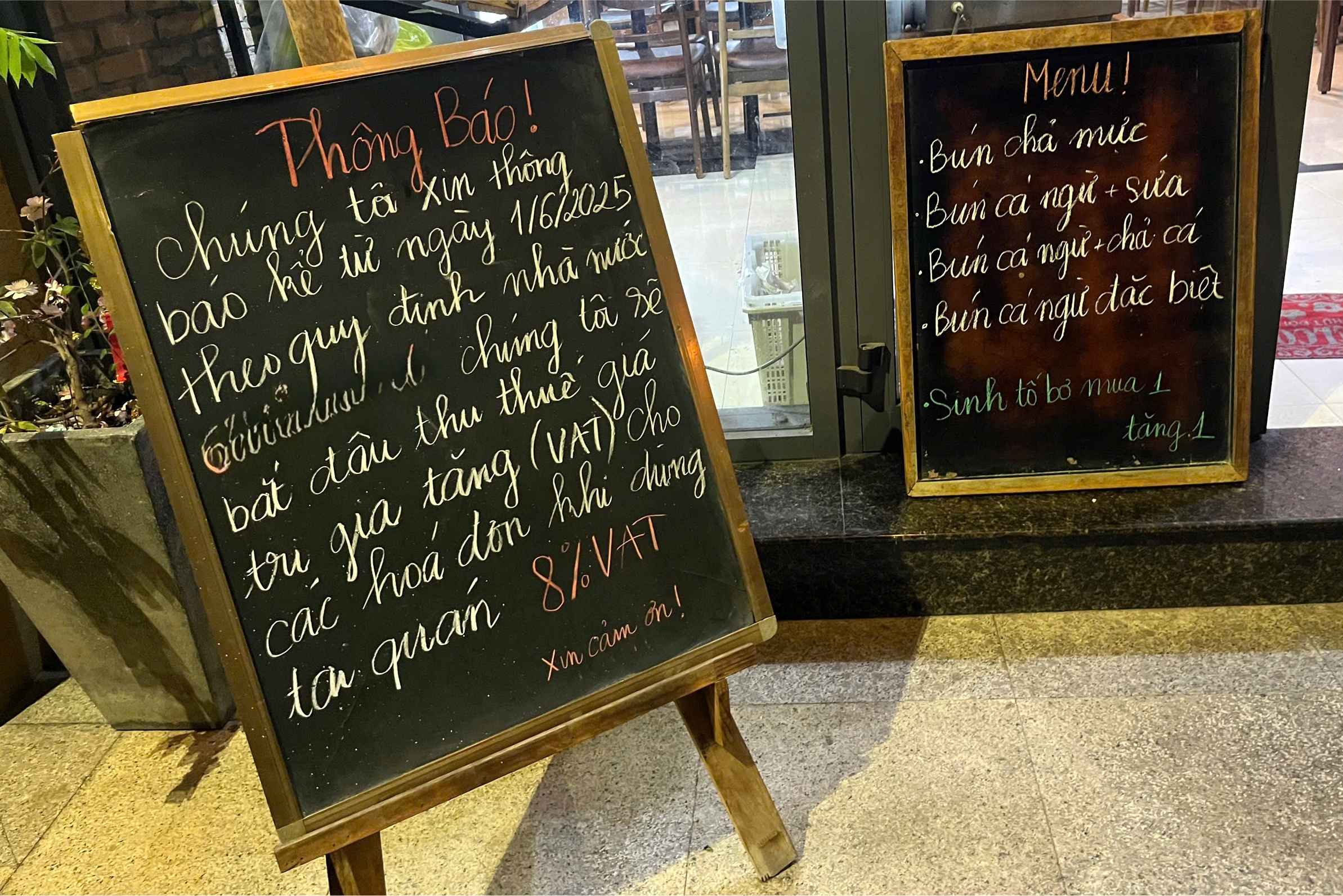
From June 1st, 2025, approximately 37,000 households and individual businesses with annual revenue exceeding 1 billion VND will be required to use electronic invoices generated from point-of-sale systems and directly connected to the tax authorities. Households with lower revenue are exempt, but are still encouraged to proactively switch to adapt to the new management requirements.
According to Circular 40/2021, business households and individuals with annual revenue from production and business activities of VND 100 million or less are exempt from Value Added Tax (VAT) and Personal Income Tax (PIT). Those with annual revenue exceeding VND 100 million will be required to pay three types of taxes and fees: business license fee, VAT, and PIT.
🔥 Things have changed!
Some shops and restaurants have started informing customers that they will include VAT in all their bills. This is different from before, when establishments only issued VAT invoices when customers requested a "red invoice" for services.
Alternatively, for businesses that do not meet the requirements for complete accounting or have not registered for the tax deduction method, the selling price already includes tax and VAT is not permitted to be separated from the selling price.
However, from June 1st, 2025, all households and individual businesses with annual revenue of 1 billion VND or more that sell goods or provide services directly to consumers will have the option to switch to using electronic invoices generated from cash registers, directly connecting data with the tax authorities.
As noted by Youth Online, On the first day the new policy was implemented, some businesses invested in equipment and software systems to issue electronic invoices generated from cash registers, connecting directly to the tax authorities and calculating VAT on sales invoices.
In addition, some businesses are still hesitant due to a lack of guidance and concerns about the high cost of investing in software and equipment; at the same time, they are worried about how including VAT in sales invoices could affect their competitiveness.
Ms. Minh Lan, the owner of a food and beverage shop in Thu Duc City, said she had heard about the regulation but couldn't implement it yet, partly because she was busy (with many jobs - PV) and partly because she wanted to wait for further guidance from local tax officials.
"I'm also worried because the cost of raw materials has increased so much, even though we've already issued invoices, but VAT hasn't been included in the price before," shared Ms. Minh Lan.
"When shopping at the market, few people pay attention to the receipt or VAT."
Share with Youth Online On the sidelines of the press conference for "Cashless Day" 2025 organized by the newspaper. Youth Speaking at a meeting on the afternoon of June 2nd, 2025, Mr. Pham Anh Tuan – Head of the Payment Department, State Bank of Vietnam – stated that recently, a number of kiosks in many markets have closed down simultaneously due to difficulties faced by sellers in declaring taxes, partly because of issues related to the origin of their inputs.
The implementation of the new regulations could force sellers to raise prices or reduce profit margins, creating a new dilemma.
“When shopping at the market, few people pay attention to the receipt or VAT, which can lead to slightly lower prices (compared to supermarkets). Now that we have to pay taxes using a different calculation method than before, we will have to push prices up. That's a problem we have to face,” Mr. Pham Anh Tuan shared.
Many businesses also stated that the compliance costs to meet the new regulations could range from several million to tens of millions of VND per year. Therefore, these businesses hope for a transitional period along with specific support policies such as free software or tax reductions during the initial phase.
According to the Tax Department, the abolition of lump-sum tax and the shift to a self-declaration and payment system based on actual revenue helps to accurately reflect business capacity and ensures the principle in the Tax Administration Law that "taxpayers self-declare, self-pay, and self-responsibility".
Resolution No. 68-NQ/TW on the development of the private economy emphasizes providing substantive and effective support to small and micro enterprises and household businesses.
Accordingly, the state will review and improve the legal framework for individual businesses, minimizing disparities in organizational management, financial and accounting systems to create favorable conditions to encourage household businesses to convert to the enterprise model.
At the same time, we will promote the digitalization, transparency, and simplification of procedures related to accounting, taxes, insurance, etc., in a way that is easy to comply with and implement. A key objective is to completely eliminate the lump-sum tax system for household businesses by 2026 at the latest.
Additionally, we offer free access to digital platforms, shared accounting software, legal consulting services, and training programs in business management, accounting, taxation, human resources, and law for small and micro enterprises, household businesses, and individual entrepreneurs.
Article source: Tuoi Tre Online Newspaper