
Money laundering is often mentioned as an act related to large-scale criminal networks, complex transactions, or illicit funds. However, in reality, the money can originate from a wide variety of criminal activities such as fraud, smuggling, counterfeiting, tax evasion, corruption, and organized gambling.
So when is money considered "illegal money"? What actions can be considered money laundering? What can individuals and businesses do to avoid inadvertently becoming a link in the process of legitimizing criminal funds?
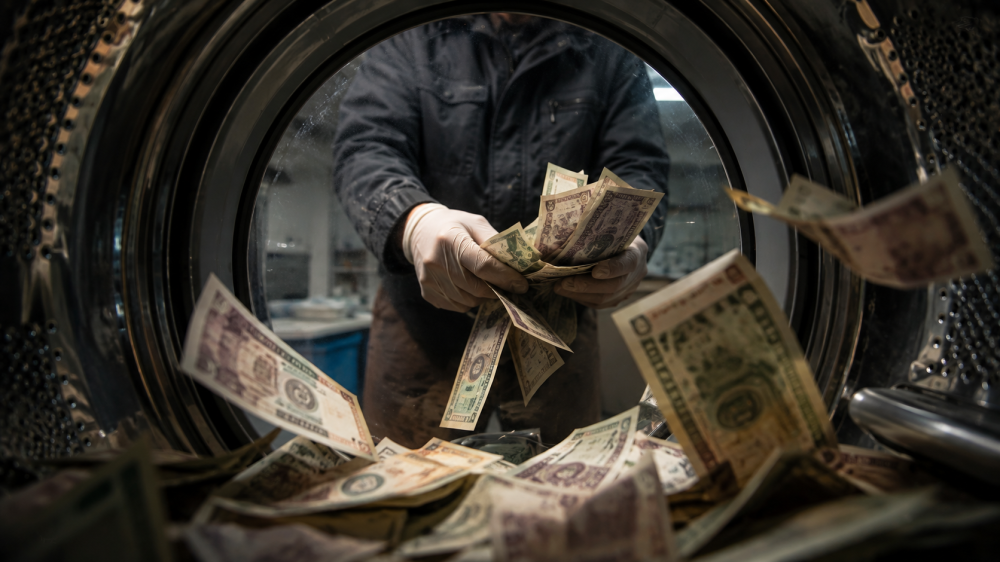
Overview of Money Laundering
Source crime – The starting point of illegal money flows
Money laundering does not usually exist in isolation but can be a form of financial laundering. linked to a “source crime” To understand money laundering, one must first understand the concept of "precursor crime".
To put it simply: The underlying crime creates illegal money or assets; money laundering is the process of handling, transferring, or concealing the origin of that illegal money or assets.
⚠️ Certain behaviors can become sources of money laundering:
- Fraudulent appropriation of property;
- Embezzlement, corruption;
- Smuggle;
- Manufacturing and trading counterfeit goods;
- Tax evasion;
- Organizing gambling, engaging in gambling;
- Illegal business activities or other criminal acts that generate material gain.
(Clause 1, Article 3 of Resolution 03/2019/NQ-HĐTP)
Money laundering – The act of concealing the origin of money.
Simply put, money laundering typically begins with funds or assets derived from criminal activity. After obtaining these funds, the perpetrators conduct transactions, transfer money, purchase assets, or use other methods to conceal their illegal origin.
For example, a person obtains 5 billion VND through fraud, then transfers the money through multiple accounts, uses it to buy real estate, or has others register properties in their names to conceal the source of the funds. If these actions fully meet the elements of the crime of money laundering as stipulated in Article 324 of the 2015 Penal Code, amended and supplemented in 2017, then the person may be prosecuted for money laundering.
The nature of an asset cannot be "legalized" simply by changing its form. Whether illegally obtained money is converted into real estate, vehicles, capital contributions, or invested in business operations, its origin must still be clarified. Therefore, in combating economic crime and money laundering, it is crucial not only to examine the current form of the asset but also to trace back: where did the asset come from, where has it traveled, and who is the actual beneficiary?
However, it is important to emphasize that Not every case of counterfeiting, fraud, smuggling, or tax evasion automatically includes the charge of money laundering. Whether or not criminal liability arises for money laundering depends on the specific actions and the elements constituting the crime according to the law.
Resolution 03/2019/NQ-HĐTP of the Council of Judges of the Supreme People's Court (still in effect) guiding Article 324 of the 2015 Penal Code, amended and supplemented in 2017, on the crime of money laundering, also mentions many predicate crimes, including crimes such as Counterfeiting and tax evasion.
Preventing money laundering risks for individuals and businesses.
Preventing money laundering risks for individuals.
Many people still think that money laundering is a very distant issue, only involving criminal networks or transactions worth billions of dong. But in reality, the risks can start from seemingly simple things: lending your bank account to someone else, receiving money on their behalf, transferring money for others, registering assets in your name, or carrying out a transaction without fully understanding the source of the money.
For example: A asks B to receive 500 million VND into their personal account under the pretext of "receiving payment for goods," then asks B to transfer the entire amount to another account.
If B was completely unaware of the illegal origin of the money, the assessment of legal liability would differ from the case where B knew the money was obtained through crime but still intentionally assisted in transferring, concealing, or legitimizing it.
Therefore, individuals should:
- Do not lend your bank account information to others without permission.
- Do not receive or transfer money on behalf of others unless the purpose is clear.
- Do not register assets, companies, accounts, or transactions in your name on behalf of others;
- Retain records of documents, contracts, and correspondence related to high-value transactions;
- When receiving an unusual amount of money, it's necessary to verify the sender and the purpose of the transaction.
- Do not carry out transactions at the request of others if there are any unusual signs or requests to conceal the source of funds.
Preventing money laundering risks for businesses.
A business can conduct dozens or even hundreds of transactions every day. Without a control mechanism, just one unusual customer, partner, or transaction can expose the business to risks that the management may not even realize.
Businesses should establish minimum control procedures for:
Customer → Supplier → Contract → Invoice → Goods/Services → Payment → Documents → Accounting.
⚠️ Businesses need to pay special attention to the following cases:
- The transaction was of significant value but lacked a contract or supporting documentation.
- Payments were made through multiple intermediary accounts.
- The partner requested that the money be transferred to an individual or legal entity unrelated to the contract;
- Buying and selling goods without documentation proving delivery and receipt;
- Revenue, expenses, or cash flow that do not reflect actual business operations;
- The partner requested a "workaround" to avoid recording the transaction;
- The transaction appears to be an attempt to conceal the true beneficiary.
Currently, the Law on Anti-Money Laundering No. 14/2022/QH15 (still in effect) and Decree 19/2023/ND-CP dated April 28, 2023 (still in effect) establish mechanisms for identifying customers, assessing risks, determining beneficial owners, and identifying large, unusual, or complex transactions involving entities within the scope of regulation; businesses can refer to these for further protection.
Resolution 03/2019/NQ-HĐTP – Clarifying money laundering acts and circumstances determining penalties.
Resolution 03/2019/NQ-HĐTP of the Council of Judges of the Supreme People's Court is a guiding document on the application of Article 324 of the Penal Code concerning the crime of money laundering and remains in effect. The resolution clarifies the concept. "Money and assets obtained through crime", and also provides guidance on behaviors that may be considered money laundering, such as engaging in financial, banking, or other transactions aimed at Concealing the illegal origin of money and assets.Using money or assets derived from crime for business or other activities; or intentionally obstructing the verification of the origin, movement, or ownership of assets.
Notably, the Resolution also provides guidance. 5 circumstances that determine the severity of the punishment. According to Article 324 of the Penal Code, this includes: Abusing one's position and authority; committing the crime two or more times; acting professionally; using sophisticated and cunning methods; and causing adverse effects on the safety of the national financial and monetary system. For example, "professional in nature" is instructed to mean carrying out money laundering activities from 05 times or more and using illicit profits from money laundering as a source of income; while "using sophisticated and cunning methods" may include using high technology, colluding with people in positions of power or authority, or employing tactics to conceal or destroy evidence, making detection and prosecution difficult.
What constitutes counterfeit goods and what are the penalties for violating regulations regarding counterfeit products?
When are goods considered counterfeit?
According to Clause 7, Article 3 of Decree 98/2020/ND-CP, counterfeit goods are not simply products that "imitate a brand." Goods can be considered counterfeit in many cases, such as:
- Having a use value or function that does not correspond to the origin, natural nature, or name of the goods;
- It has no practical value or use;
- The intended use does not match the information published or registered;
- At least one quality indicator, basic technical characteristic, or quantitative value of the main substance that contributes to the usability or function only reaches 70% or less of the minimum level according to the registered, published, or labeled standards and regulations; or as indicated on the packaging.
- Falsification of the name, address of the manufacturer, origin, registration number, barcode, or packaging in cases prescribed by law.
Therefore, counterfeit goods do not necessarily have to be products that completely copy another brand's product.
What are the penalties for selling counterfeit goods?
Not all acts of producing or trading counterfeit goods are subject to criminal prosecution. The line between administrative penalties and criminal liability depends on the nature and extent of the violation, the value of the goods, the amount of profit earned, and the consequences caused by the act.
Regarding administrative penalties, the act of producing or trading counterfeit goods that does not yet constitute a crime will be handled according to Articles 9-14 of Decree 98/2020/ND-CP (still in effect). The penalty level is determined depending on the act and the value of the counterfeit goods; for certain special product groups such as food, medicine, cosmetics, medical equipment, etc., the penalty level may be higher as prescribed.
Regarding criminal penalties, when an act reaches the criteria stipulated in the Penal Code, the perpetrator may be prosecuted. For example, for the production and sale of counterfeit goods in general, Article 192 of the 2015 Penal Code, as amended in 2017, stipulates criminal liability based on factors such as the value of the counterfeit goods, illicit gains, damages, and other circumstances as prescribed by law. The basic penalty range may be a fine from 100 million to 1 billion VND or imprisonment from 01 to 05 years, with increased penalties in more serious cases.
In particular, for counterfeit food, food additives, and other food products, Article 193 of the Penal Code stipulates stricter penalties, with a basic sentence of 02 to 05 years imprisonment, which can be increased to 10–15 years, 15–20 years, or life imprisonment depending on the nature, extent, and aggravating circumstances as prescribed by law.
From a practical perspective: The fake milk production case of Z HOLDING company.
The incident occurred at Z Holding Joint Stock Company, tried and sentenced by the Hanoi City People's Court on [date] 14/01/2026 Regarding the 18 defendants, according to the verdict, from 2023 to May 2025, the Z Holding leadership team organized the production, distribution, and consumption of the product. 26 dairy products were identified as counterfeit., with revenue from these products exceeding VND XNX billion.
To carry out the crimes, the defendants directed the establishment of 26 companies, 27 sales systems, 208 sales groups, and 179 individual business households to legitimize the production and trading of goods; declare taxes; and legitimize the flow of money obtained from the crimes.
To conceal actual revenue and evade financial obligations to the State, the defendants directed and led a team of accountants to file tax returns through companies within the Z Holding system and individual business households, committing violations that resulted in tax losses exceeding 1.633 billion VND.
The court determined this to be an exceptionally serious case, with the defendants being tried on three charges: "Producing and trading counterfeit food products," "Violating accounting regulations causing serious consequences," and "Money laundering," all involving coordinated and systematic criminal activity, carried out over a long period, and aided by accomplices.
This is a practical sentence that combines both the crimes of counterfeiting and money laundering.
Expert's perspective
Resolution 03/2019/NQ-HĐTP provided guidance on the application of Article 324 of the Penal Code concerning money laundering, while Joint Circular 02/2023/TTLT-BCA-HDNDTC-TANDTC stipulated the mechanism for coordinating information exchange in the investigation, prosecution, and trial of money laundering offenses, thereby demonstrating the need for clarification. the origin and flow of money and assets It plays a significant role in the processing.
Money laundering is not simply about transferring money through multiple accounts or turning money into assets; its core principle lies in... Concealing or falsifying the illegal origin of money or assets. Therefore, preventing money laundering should begin with identifying the source of the crime, controlling the source of funds, and exercising caution in financial and business transactions.
For individuals and businesses, it's important not just to "Where does the money come from?", but you also need to know "Who am I trading with, what is the purpose of the trade, and who actually benefits?"A careless act of lending or lending accounts, registering assets in one's name, or receiving money transfers on behalf of others can inadvertently turn someone into a link in an illegal money flow.