
The activity of purchasing scrap metal from individuals is considered one of the smallest links in the supply chain. In reality, businesses often encounter direct collectors, bulk buyers, collection points, or individuals who regularly buy scrap metal and then resell it to businesses. This mix creates tax risks.
Official document No. 10229/BTC-CT dated July 15, 2026, from the Ministry of Finance, as cited by the Tax Department. Official document No. 6479/CT-QLNT August 28, 2026, shows that the regulatory body is approaching this activity in an increasingly clearer direction: Tax obligations, invoices, and supporting documents must adhere to the correct parties and reflect the true nature of the transaction, rather than being handled solely by the purchasing business. This is a point that scrap metal purchasing businesses need to pay special attention to.
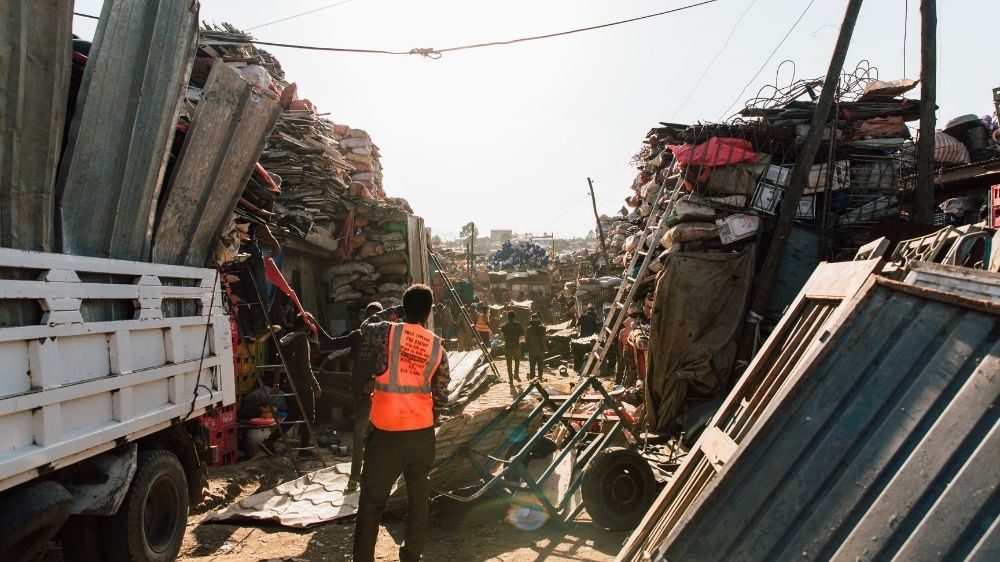
Businesses cannot simply look at the fact that "the seller is an individual."
In practice, a business can purchase scrap metal from many different sources:
- People who directly collect paper, plastic, bottles, or small scrap materials;
- Individuals purchase these items from multiple collectors.
- Households or individuals engaged in the scrap metal business;
- These collection points are used for sorting and then reselling in large quantities.
In terms of form, all of them are possible. "Individuals selling scrap metal"However, in terms of legal and tax aspects, they are not necessarily the same entity. This is the most important point when a business decides to use invoices, purchase orders, or other substitute documents.
According to the Decree 320/2025/ND-CPHowever, corporate income tax law still allows businesses to prepare a list for certain cases of purchasing goods and services without invoices, including the following cases: Buy scrap metal directly from the collectors. and some cases of purchases from households or individuals with revenue below the VAT tax threshold.
Therefore, the first question that needs to be asked is not: "Does the seller have an invoice?" It should be: "Who exactly is selling scrap metal to businesses, and in what capacity are they doing so?" These are two completely different issues.
"Those who directly collect scrap metal" and those who trade in scrap metal should not be equated.
An individual who collects scrap materials themselves and resells small quantities is a relatively easy case to identify.
But the situation changes significantly if an individual:
- Regularly buy items from various other collectors;
- There is a designated assembly point;
- Transportation is available;
- Sorting or preliminary processing organization;
- Someone did it;
- Regular sales to one or more businesses;
- It has large and stable sales.
In that case, the business needs to consider whether this is still relevant. "the person who directly collects" or already an entity engaged in the scrap metal business.
Official document No. 6479/CT-QLNT This is a notable indicator of how the regulatory body views this issue. The Ministry of Finance distinguishes the obligations of households and individuals engaged in scrap metal business based on revenue levels and requires them to fulfill tax and invoice obligations according to the regulations applicable to household and individual businesses.
From 2026, the revenue threshold for business households and individual businesses to be exempt from tax will be set at... 01 billion VND/year theo Decree 141/2026/ND-CP.
But it's important to understand precisely: The VND 01 billion threshold is a threshold for determining tax obligations, not the sole criterion for determining whether someone is engaged in business activities. The two questions must be separated:
- First: Is that person involved in the scrap metal business or simply collecting scrap directly?
- Secondly: If they are running a business, what are their tax obligations?
Confusing these two issues can lead businesses to apply the wrong documentation mechanism from the outset.
The biggest risk doesn't lie in the seller's tax liability.
This is an issue that businesses often overlook. A person who actually collects scrap metal on their own usually only generates relatively low transaction value in a day.
When an individual sells to a business in large, consistent quantities, the management questions that need to be addressed are not just: "Has this person's net worth exceeded 01 billion VND yet?" But more importantly: "Where does this person's supply come from?" If that person actually buys scrap metal from many other people, collects it, and then sells it to a business, their position in the supply chain is fundamentally different from that of someone who directly collects it.
In that case, the business would continue to file documents in that manner. "Buy scrap metal directly from the collectors" This could create a much greater risk than the amount of tax the seller would otherwise have to pay.
Risks can spread along the entire chain: Incorrectly identifying the seller → using the wrong type of document → inability to prove the origin of goods → risk of deductible expenses → risk related to invoices and documents → risk when the tax authorities verify the transaction.
Therefore, businesses should not view purchase invoices simply as a "replacement for invoices." Purchase invoices are only suitable when... The nature of the transaction actually falls under the category where the law permits the use of a statement..
Why does the Ministry of Finance not accept the mechanism of businesses paying taxes on behalf of others?
One of the proposals put forward was to allow businesses to purchase scrap metal. Filing and paying taxes on behalf of households or individuals involved in waste collection., thereby resolving the issue of input documents.
The Ministry of Finance disagrees with this approach. According to Official document No. 6479/CT-QLNTThe addition of a mechanism allowing businesses to declare and pay taxes on behalf of scrap metal sellers is considered inconsistent with current tax management regulations.
One notable reason cited is that the purchasing business simultaneously: As the buyer → as the person filing the tax return → as the person paying the tax return → then using that same document to account for their expenses. According to the Ministry of Finance, this mechanism poses risks regarding invoices, documents, and the authenticity of transactions.
What is noteworthy here is that the regulatory body did not approach the issue in a simplistic way: "Will the taxes be paid?" which in the following direction: "Who carries out the economic activity and who is responsible for the tax obligations associated with that activity?"
In other words, if an individual is actually engaged in the scrap metal business, the obligations of registration, tax declaration, invoice usage, and related duties must be handled by that individual according to regulations. The fact that the purchasing business pays a tax on their behalf does not automatically make the entire transaction valid.
No receipt does not mean the expense cannot be charged.
Conversely, businesses should not assume that purchasing scrap metal from individuals without invoices automatically disallows the expense.
Corporate income tax laws have anticipated several cases of purchases without invoices and allow businesses to prepare a list along with relevant documents and records if the conditions are met. Official document No. 6479/CT-QLNTThe Ministry of Finance also cited this mechanism when responding to the Association's proposal.
This shows that the issue isn't about trying to create an invoice or tax document by any means necessary. The issue is that businesses must... correctly identify the transactionThen, use the correct type of document permitted by law for that transaction.
These are two very different approaches.
The activity of collecting and sorting scrap materials is still subject to VAT.
The Vietnam Paper and Pulp Association also proposed considering exempting the collection and sorting of waste paper from VAT in order to encourage recycling and the development of a circular economy.
The Ministry of Finance did not approve this proposal. Official document No. 6479/CT-QLNTThe activity of collecting and sorting waste paper is a provision of goods and services subject to Value Added Tax (VAT), and in principle, the tax rate is applied according to general regulations.
The Ministry of Finance's argument also reveals a noteworthy principle: VAT policy is determined based on goods, services, and the nature of the transaction, not solely on the objective of encouraging a particular industry.
Therefore, an activity that is meaningful to the environment or the circular economy does not automatically become exempt from VAT.
Management trends are reaching even the smallest links in the transaction chain.
The most noteworthy aspect of this document doesn't lie solely in the paper or plastics industries. It reveals a broader regulatory trend.
Those who directly collect scrap materials may be among the smallest economic entities: collecting a small amount of paper, plastic, and bottles each day and reselling them. But when goods from thousands of such small transactions enter businesses, incurring significant costs and ultimately impacting the businesses' taxable income, regulatory authorities begin to pay attention. the entire transaction formation chain.
The approach in Official document No. 6479/CT-QLNT This is quite evident:
- Identify the seller;
- Distinguish between those who directly collect the materials and those who trade in them.
- Determine revenue;
- Determine tax obligations;
- Determine billing obligations;
- Verify the authenticity of transactions;
- And verify the verifiable nature of the transaction on the purchasing company's side.
This trend is also consistent with Law on Tax Administration No. 108/2025/QH15The new law takes effect from July 1, 2026. It strengthens management based on compliance levels, analysis, and risk assessment of taxpayers; however, the regulations on tax declaration, tax calculation, and the use of electronic invoices for household businesses and individual businesses have been in effect since January 1, 2026.
It can be seen that the management approach is gradually shifting away from simply checking. "Does the business have a complete set of documents?" Moving on to a more in-depth question: "Is this transaction real? Who is the seller, and how did the economic activity actually take place?"
What controls do scrap metal purchasing businesses need to have?
For businesses involved in regular scrap metal purchasing, control should not be limited to accounting. The business should develop a purchasing process capable of addressing at least four key issues.
Who is the real seller?
Businesses need to differentiate between those who directly collect scrap metal and those who are involved in buying, sorting, and reselling it. It shouldn't be assumed that all individuals selling scrap metal belong to the same group.
Is the transaction size appropriate for the seller's status?
Transaction value, sales frequency, transportation methods, collection points, and sourcing methods are all indicators that help businesses assess the nature of the seller. An individual selling a few hundred thousand dong worth of scrap metal per day and an individual consistently delivering large quantities should not be judged as the same.
Do the documents match the nature of the transaction?
The principle should be:
First, identify the transaction → determine the seller's tax obligations and invoices → then determine the type of business document to use.
One should not do the opposite by choosing a convenient type of document and then trying to fit the transaction into that category.
Can the business demonstrate its supply chain?
A good record-keeping system is more than just a list of items. Businesses need to be able to connect data:
Seller → Delivery time → Weighing/Delivery slip → Payment → Warehousing → Inventory → Input into production → Finished goods or goods sold.
When this data is consistent, the likelihood of proving the authenticity of the transaction is significantly higher.
Expertis's Perspective from Consulting Practice
The tax risk associated with scrap metal purchasing activities doesn't typically arise from a single transaction. It develops when a particular processing method is repeated thousands of times.
If a business uses a receipt to purchase a small amount of scrap metal directly from a collector, that transaction may be in accordance with the legal framework. However, if the same mechanism is used to purchase very large quantities regularly from individuals suspected of being part of an organized group that buys and resells the scrap, the risk takes on a different nature.
At that point, the issue was no longer simply: "Does this list have all the necessary signatures?" Instead: "Are businesses using the correct legal mechanisms for the right purposes?"
This is also why businesses should manage their procurement activities from the outset instead of only supplementing documentation when tax authorities conduct an audit.
Official document 10229/BTC-CT and Official Document 6479/CT-QLNT This sends a significant message to scrap metal purchasing businesses: Small-scale transactions no longer equate to transactions that fall outside the requirements of transparency.
Businesses can still use the list-based mechanism in cases where the law permits it. However, a prerequisite is that... Identify the correct seller and the true nature of the transaction..
The biggest risk, therefore, does not lie in the seller lacking an invoice, but in the business misidentifying a trader as the direct collector, thereby using the wrong documentation mechanism for the entire procurement chain.
In the context of increasingly data-driven and risk-based tax administration, a company's procurement system needs to demonstrate not only that it is capable of managing its finances. How much to buy and how much to pay?, but also need to answer three fundamental questions:
- Who should I buy from?
- In what capacity is that person selling?
- Are the business documents being used actually appropriate for that transaction?