
On September 25, 2026, the Ministry of Finance issued Circular 58 / 2026 / TT-BTCThe guidelines on accounting regime for micro-enterprises will take effect from July 1st, 2026, and replace Circular 132/2018/TT-BTC after more than seven years of application.
📌 KEY POINT
♦ Micro-enterprises record accounting entries based on the method of paying VAT and corporate income tax. This applies to the fiscal year beginning July 1, 2026.
♦ Household businesses and individual business owners may choose to apply this accounting system if they so wish.
♦ If a business's fiscal year coincides with the calendar year, the first accounting period to apply the new system will be the following fiscal year.
Expand the scope of application.
Besides micro-enterprises, now Household businesses and individual business owners, if they so wish, may choose to apply Circular 58/2026/TT-BTC to carry out their accounting work.This differs from the current regulation (Circular 132/2018/TT-BTC) which only applies to micro-enterprises (without mentioning household businesses or individual business owners).
Having chosen to apply the accounting regime according to this Circular, households and individual businesses must Apply consistently throughout a fiscal year.Changes to the accounting system can only be implemented on the beginning of the following fiscal year.
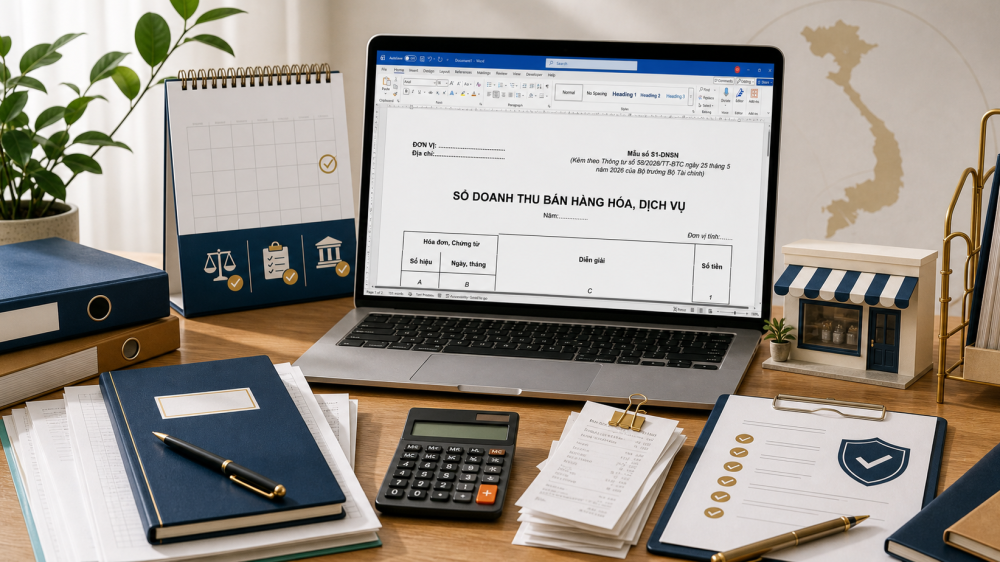
New regulations for businesses using electronic invoices.
In cases where the entity is registered to use electronic invoices and receives support in determining and notifying the amount of VAT, corporate income tax, and other taxes payable. (if any) by the tax authority's tax management information system; micro-enterprises Use the accounting ledger templates attached to the Circular to track and reconcile the tax payable as notified by the tax authorities. (Clause 6, Article 4).
04 methods of recording accounting entries
Instead of the two current methods of record-keeping, Circular 58 stipulates... Four cases corresponding to the methods of paying VAT and corporate income tax.Micro-enterprises determine the list of accounting books to use for one of the specified cases based on their tax payment method:
| 1. Pay VAT and corporate income tax at a percentage (%) rate on revenue. | |
| Sales revenue register for goods and services | Form S1-DNSN |
| 2. Pay VAT at a percentage rate on revenue and corporate income tax on taxable income. | |
| Sales revenue register for goods and services | Form S2a-DNSN |
| Detailed ledger of revenue and expenses | Form S2b-DNSN |
| Detailed register of materials, tools, products, and goods. | Form S2c-DNSN |
| Cash register | Form S2d-DNSN |
| 3. Pay VAT using the deduction method and pay corporate income tax at a percentage rate on revenue. | |
| Sales revenue register for goods and services | Form S3a-DNSN |
| VAT tax obligation tracking log | Form S3b-DNSN |
| 4. Pay VAT using the deduction method and pay corporate income tax on taxable income. | |
| Detailed ledger of revenue and expenses | Form S2b-DNSN |
| Detailed register of materials, tools, products, and goods. | Form S2c-DNSN |
| Cash register | Form S2d-DNSN |
| VAT tax obligation tracking log | Form S3b-DNSN |
For details on the content and methods of accounting record keeping, businesses should refer to the guidelines in Articles 5 to 8 of the regulations. Circular 58 / 2026 / TT-BTC.
Groups paying corporate income tax on taxable income (cases under Articles 6 and 8) Responsible for preparing and submitting annual financial statements and business performance reports. In accordance with the guidelines in Article 10 of the Circular, the report must be submitted within 90 days from the end of the fiscal year.
| Financial reporting system for micro-enterprises | |
| Report on the financial situation | Form B01-DNSN |
| Report on business results | Form B02-DNSN |
At the same time, micro-enterprises may consider adopting the accounting system for small and medium-sized enterprises (SMEs) to suit their business operations and management requirements. However, this system must be applied consistently throughout a fiscal year. Changes to the applied accounting system can only be made on the start date of the following fiscal year.
What should businesses do?
Micro-enterprises currently accounting according to Circular 132/2018 need to proactively prepare to ensure compliance when the new regulations come into effect.
| ♦ |
Identify the applicable ledger categories. Based on the current VAT and corporate income tax filing methods, the correct accounting book categories, recording methods, and financial statement preparation should be applied in accordance with regulations. |
| ♦ |
Convert balance When switching to a new accounting system (due to a change in the method of paying VAT, corporate income tax, or due to selecting/deselecting the accounting system for small and medium-sized enterprises), businesses use the ending balances in the previous period's accounting records to transfer to the beginning balances of the corresponding records for the next period. |
| ♦ |
Modify or supplement the document forms (if necessary). Businesses may design, modify, or supplement accounting forms and records to suit their production and business activities and management requirements, but must comply with the provisions of the Accounting Law, ensuring that the financial situation of the business is fully, promptly, truthfully, and transparently reflected. |
Note
The process of determining the ledger categories and transferring balances should be completed. before the first accounting period under the new regime. To avoid discrepancies in opening balances, if an organization no longer meets the criteria for a micro-enterprise during the year, Circular 58 will be applied until the end of the current fiscal year, and a suitable accounting regime will be implemented from the following fiscal year.
Circular 58/2026/TT-BTC simplifies the accounting regime for micro-enterprises with practical and flexible adjustments, better suited to the realities of production and business operations. Micro-enterprises and household businesses need to quickly identify the appropriate list of accounting books and make timely preparations to ensure compliance when the new regulations come into effect.