
📌 08 cases where electronic invoices are not required 01 / 07 / 2026:
- Household businesses and individual business owners selling goods and services must prepare a purchase list. According to the law on corporate income tax.
- HKD, CNKD lease real estate; provide digital content to foreign countries. (Entertainment, video games, movies, photos, music, digital advertising).
- HKD and CNKD act as lottery agents, insurance agents, and multi-level marketing salespeople. The business has already deducted the tax at source.
- Specific financial and insurance revenues (Reinsurance, accepting deposits, issuing securities, selling debt, foreign exchange transactions and derivative products).
- Contributing capital in the form of assets of business organizations and individuals into economic organizations.
- Transfer of assets for dependent accounting units; assets transferred during division, separation, merger, acquisition, or conversion of business type.
- Lending machinery and equipment for processing goods. — No payment, no transfer of ownership.
- Three specific groups under VAT law: Internal circulation, self-supply for production and business purposes, and revenues not related to the sale of goods or services.
On November 30, 2026, the Government issued... Decree 254/2026/ND-CP The detailed regulations of the Law on Tax Administration No. 108/2025/QH15 on electronic invoices and electronic documents, effective from July 1, 2026, stipulate the following regarding the subjects to which electronic invoices apply:
Target users of electronic invoices
Article 6 Decree 254/2026/ND-CP Regulations governing businesses, economic organizations, business households, and individual business owners engaged in activities. selling goods, providing services All of them are subject to the use of electronic invoices. Specifically:
|
Electronic invoices have a tax authority code. |
Economic organizations, other organizations, business households, individual businesses, and high-risk tax cases as prescribed by the Minister of Finance when Selling goods, providing services. |
|
Electronic invoices without a tax authority code. |
Doing business in specialized fields: Electricity, petroleum, postal services, telecommunications, clean water, finance and banking, securities, crypto assets, services supporting carbon trading, insurance, healthcare, e-commerce, supermarkets, trade, air, road, rail, sea, and inland waterway transport; and economic organizations that have or will conduct electronic transactions with tax authorities, possessing information technology infrastructure, accounting and invoicing software that meet the requirements for data creation, retrieval, storage, and transmission. ⚠️ In high-risk tax situations, invoices with codes must still be used. |
|
Electronic invoices from cash registers |
Selling goods and providing services directly to consumers: Shopping malls; supermarkets; retail (excluding automobiles, motorcycles, and other motor vehicles); food and beverage; restaurants; hotels; passenger transport and services directly supporting road transport; arts, entertainment, and recreation services; film screenings; other personal services. 💡 If the business has already registered for invoices with or without codes according to the two groups above, it is not mandatory to register additional invoices from the cash register. |
|
Electronic invoices with tax authority codes, and electronic invoices generated from cash registers connected to the tax authority's data system. |
Household businesses, individual businesses Having annual revenue exceeding 01 billion VND; selling assets that require registration of ownership or usage rights, or having a need for use even if not mandatory. |
In addition, the tax authorities issue electronic invoices with codes. each time it occurs For specific cases: non-business organizations that have taxable transactions; entities that are temporarily suspended, cease operations, are undergoing bankruptcy proceedings, or are subject to forced cessation of invoice use but still need invoices for legitimate transactions (Clause 2, Article 6).
08 cases where electronic invoices are not required.
Article 7 of the Decree specifies the following special cases where electronic invoices are not required:
| 01 |
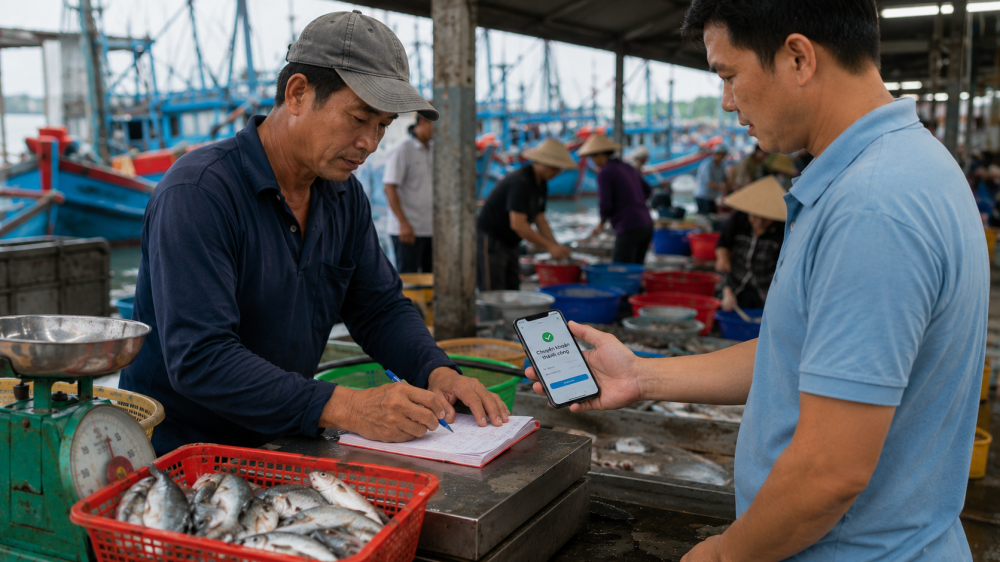
The sale of goods and services is accompanied by a purchase order prepared by the buyer. Household businesses and individual businesses selling goods and services are required to prepare a list of purchased goods and services according to corporate income tax law (except for households and individuals who have registered to use electronic invoices) — typically in the case of agricultural, forestry, and aquatic products sold directly by producers or fishermen, where the purchasing enterprise records the expense using a list instead of an invoice. |
| 02 |
Real estate rental; providing digital content to foreign markets. Household businesses and individual businesses with income from real estate rental activities; income from providing digital content products and services related to entertainment, video games, digital films, digital photos, digital music, and digital advertising to organizations and individuals abroad. This regulation directly removes obstacles for individuals creating content and developing applications and games that generate revenue from foreign platforms. |
| 03 |
The dealer has received tax deduction at source from the business. Household businesses and individual business owners acting as lottery agents, insurance agents, or multi-level marketing agents, where the lottery, insurance, or multi-level marketing companies have already deducted taxes in accordance with tax management laws. |
| 04 |
Specific fees, financial charges, and insurance charges. Fees and other income arising from reinsurance activities (reinsurance cession, reinsurance cession commissions and other reinsurance cession income); receiving deposits; financing activities (issuing certificates of deposit, issuing primary securities, issuing securities); selling debt; foreign exchange transactions and derivative products. ⚠️ Foreign currency exchange only: At the end of the month, the unit uses the data management system to compile a detailed summary of transactions that occurred during the month, is responsible for the accuracy of each transaction, and provides the summary when requested by the tax authorities or other competent state agencies. |
| 05 |
Contributing capital in the form of assets Contributing assets from a business organization or individual to an economic organization is a capital transfer transaction, not a purchase or sale, and therefore does not create an obligation to issue an invoice. |
| 06 |
Internal asset transfers and during restructuring. Assets transferred from the parent company to dependent accounting units and vice versa; transfers between dependent accounting units within a business entity; assets transferred during division, separation, merger, acquisition, or conversion of business type. Note: Transfers of assets between independent accounting units or between member units with full legal personality within the same organization must still be invoiced electronically, just like the sale of goods (point e, clause 3, Article 6). |
| 07 |
Lending machinery and equipment for processing. The machinery and equipment lent are fixed assets and tools used for processing goods of the lender; no payment is collected, and no ownership is transferred. |
| 08 |
Three specific groups of cases refer to Decree 181/2025/ND-CP on value-added tax. (a) Goods and services transferred internally to continue the production and business process within a business establishment — internal warehouse transfers, material shipments, semi-finished product transfers; (B) Goods and services exported or provided by a business establishment to serve its own production and business activities, including fixed assets that it constructs or produces itself; (C) Income not related to the sale of goods or provision of services — monetary compensation (including compensation for land and assets on land when land is expropriated), bonuses, third-party claims from insurance activities, collection fees, fees for collection and disbursement on behalf of state agencies, and financial income. |
Not issuing an invoice doesn't mean there's no documentation!
Exceptions are transaction-specific, not unit-specific.
A single entity may have both transactions that do not require invoicing and those that do. A credit institution may not issue invoices for deposit transactions but may still issue invoices for service fees; a real estate lessor may not issue invoices for rent but, if simultaneously engaged in retail sales, the retail sales activity is subject to its own separate obligations as stipulated in Article 6.
Substitute documents serve as the basis for explanation.
In many cases, invoices are not issued, but alternative supporting documents are required: a purchase statement prepared by the buyer in accordance with corporate income tax law, a summary of detailed foreign currency sales transactions prepared at the end of the month, along with documents related to capital contributions and asset transfers in accordance with relevant accounting and tax laws. These documents serve as the basis for recording expenses and providing explanations during audits and inspections—leaving this set of documents blank carries risks no less significant than lacking an invoice.
Buyer's rights
Article 18 stipulates that buyers have the right to request sellers to issue and deliver a legally valid invoice when purchasing goods or services — except in cases where electronic invoices are not required. Sellers subject to this exclusion should be aware of their legal basis to provide consistent explanations to customers, especially corporate customers who require expense documentation.
What should businesses and household businesses do?
- Review transactions using a three-step process: Does the transaction involve the sale of goods or the provision of services? → Which category does it fall under in Article 6? → Does it fall into one of the eight cases in Article 7?
- Standardize the process for replacement documents. Each transaction that does not require an invoice must be recorded systematically and readily available upon request from the tax authorities.
- Household and individual business owners Compare the revenue threshold of 01 billion VND/year and the business model to choose the correct invoice format to apply, whether it includes a code or is issued via a cash register.