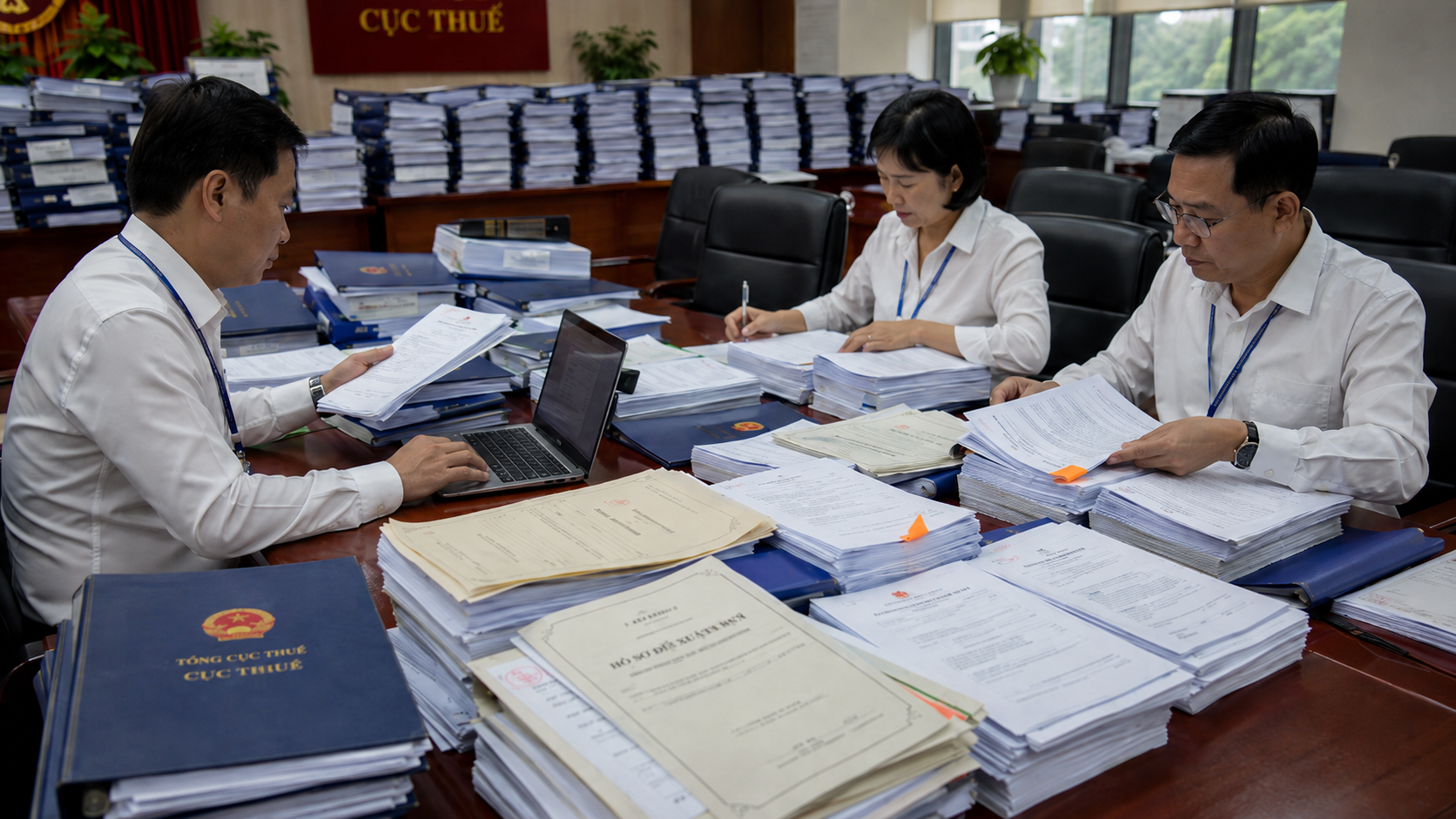
All electronic invoice data is concentrated at the General Department of Taxation To provide services to sellers, buyers can independently look up and compare invoice data with data managed by the tax authorities.
Invoices are no longer stored in fragmented files at electronic invoice providers, or individually within businesses.
The centralized model of the General Department of Taxation's Electronic Invoice System.

Electronic invoice data is sent to the tax authorities via a dedicated connection with security mechanisms in place during transmission, thus ensuring the safety of electronic invoice data.
Tax officials are granted access to electronic invoice data according to their assigned functions and duties; the IT system manages and monitors the use of electronic invoice data by tax officials.
Solutions for implementing e-invoices must ensure the following requirements: e-invoices are protected by the digital signature of the seller; if the signature is erased (data altered), the integrity of the digital signature will be compromised. In case of forgery, the tax authorities will be able to detect and handle it immediately according to regulations using the IT system; and invoice information must be provided promptly so that buyers, third parties, and relevant state management agencies can verify and check the validity and legality of the invoice.
Activate the electronic invoicing system.
On November 21, 2021, at the headquarters of the General Department of Taxation, the Ministry of Finance held an online conference to announce the implementation of the Electronic Invoice (E-invoice) system. Attending and directing the conference were Comrade Le Minh Khai – Secretary of the Central Committee of the Communist Party of Vietnam, Deputy Prime Minister; Comrade Ho Duc Phoc, Member of the Central Committee of the Communist Party of Vietnam, Minister of Finance; Comrade Pham Tan Cong – President of the Vietnam Chamber of Commerce and Industry (VCCI), along with representatives from the leadership of the six provinces and cities participating in the first phase of the E-invoice implementation.
According to the report presented at the conference, since 1991, the General Department of Taxation has applied information technology (IT) to its management work. To date, after 30 years of continuous investment and development, the IT system of the tax sector has developed comprehensively, digitizing all aspects of tax management, from receiving and processing documents, accounting for tax obligations of individuals and businesses nationwide with over 41 million tax identification numbers and hundreds of millions of tax records, to transmitting and receiving directive documents within the tax agency.
In particular, with 12 years of developing and providing online public services, the General Department of Taxation is one of the pioneering state agencies in the field of providing electronic services to citizens and businesses.
The General Department of Taxation has consistently strived to reform and modernize its management practices to provide convenience for citizens and businesses. Accordingly, as early as 2010, the General Department of Taxation proposed to the Ministry of Finance to submit to the Government a regulation to supplement electronic invoices into the accounting system, creating a legal basis for businesses to modernize their management practices in line with the development of modern society.
According to assessments, although e-invoices are a new technology with many advantages over paper invoices, changing a long-standing mechanism is a huge challenge, requiring extraordinary efforts from both tax authorities and taxpayers. To enhance the legal validity of using e-invoices, the Tax Administration Law No. 38/2019/QH14 has added a chapter on e-invoices.
To put the regulations on e-invoices in the Tax Administration Law into practice, the Ministry of Finance promptly issued a Circular guiding the implementation of e-invoices and issued decisions to deploy the e-invoice system in two phases. Specifically, phase 1 in six provinces and cities (Hanoi, Ho Chi Minh City, Hai Phong, Quang Ninh, Phu Tho, and Binh Dinh) started in November 2021, and phase 2 in the remaining 57 localities, ensuring that by June 30, 2022, 100% of businesses nationwide have adopted e-invoices.

Speaking from the Hanoi location, Chairman of the Hanoi People's Committee Chu Ngoc Anh stated that Hanoi is honored to be one of the six localities selected by the Ministry of Finance to be the first in the country to implement e-invoices. Recognizing e-invoices as a crucial solution in modernizing tax management, contributing to improving the business environment, saving time and costs, and reducing risks, 99% of businesses and organizations in the capital city have now announced the issuance of e-invoices.
Chairman Chu Ngoc Anh emphasized that with the benefits that e-invoices bring, the Hanoi city leadership will create the best possible conditions for businesses and taxpayers in converting to and using e-invoices according to the new regulations. In addition, the Hanoi People's Committee will regularly direct the Hanoi Tax Department to coordinate with relevant departments and agencies to compile a list of obstacles and difficulties, thereby promptly providing solutions to address them for businesses and taxpayers, minimizing potential inconveniences.
Chairman Chu Ngoc Anh stated that Hanoi is now ready to activate e-invoices and committed to working alongside businesses and taxpayers in the implementation of e-invoices, supporting the resolution of all difficulties and obstacles faced by businesses and taxpayers, ensuring the progress and quality of the set objectives.
At the Ho Chi Minh City venue, Chairman of the People's Committee of Ho Chi Minh City, Phan Van Mai, stated that, along with the five localities selected to implement e-invoices in phase 1, the People's Committee of Ho Chi Minh City has focused on directing the implementation of the task, while also reviewing and preparing the necessary conditions regarding human resources, technical solutions, and strengthening communication, guidance, and support for businesses in implementing e-invoices in conjunction with digital transformation within their enterprises.
To date, under the direction of the City's Steering Committee for the Implementation of Electronic Invoices and the close guidance of the Ho Chi Minh City Tax Department, the implementation of electronic invoices has initially operated according to schedule and effectively throughout the city.
It can be affirmed that the announcement of the Electronic Invoice System is a significant milestone in the digital transformation process of the Tax sector, helping to innovate tax management and invoice management in a modern and transparent direction.