
In modern human resource management, Competency framework It is no longer an abstract concept but a concrete measure of human value to the organization.
However, to consistently manage and develop competencies, businesses need a tool that can standardize, measure, and clearly define them—and that tool is a competency dictionary.
1. What is a competency dictionary?
Dictionary of abilities It is a set of definitions, descriptions of behavior, and levels of performance for each competency required within an organization.
This is the "common language" between the business and its employees — helping everyone understand each other. Which competencies are important, how are they assessed, and how are they developed?
A comprehensive competency dictionary typically includes:
-
A list of competency groups (core, leadership, expertise, support).
-
Provide a clear definition for each competency.
-
Many behavioral indicators Describe how competence is demonstrated.
-
System proficiency level From basic to advanced.
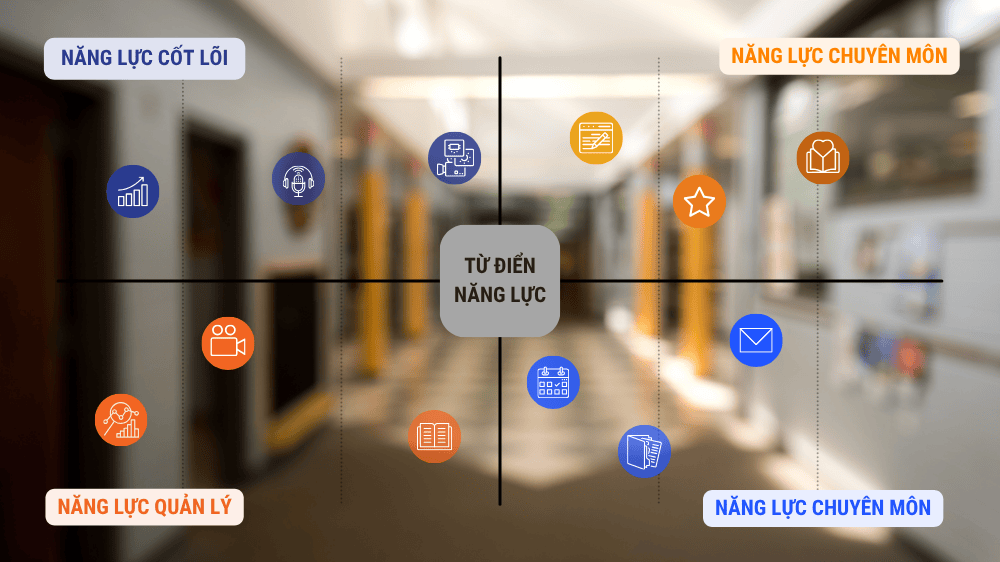
2. Structure of the competency dictionary
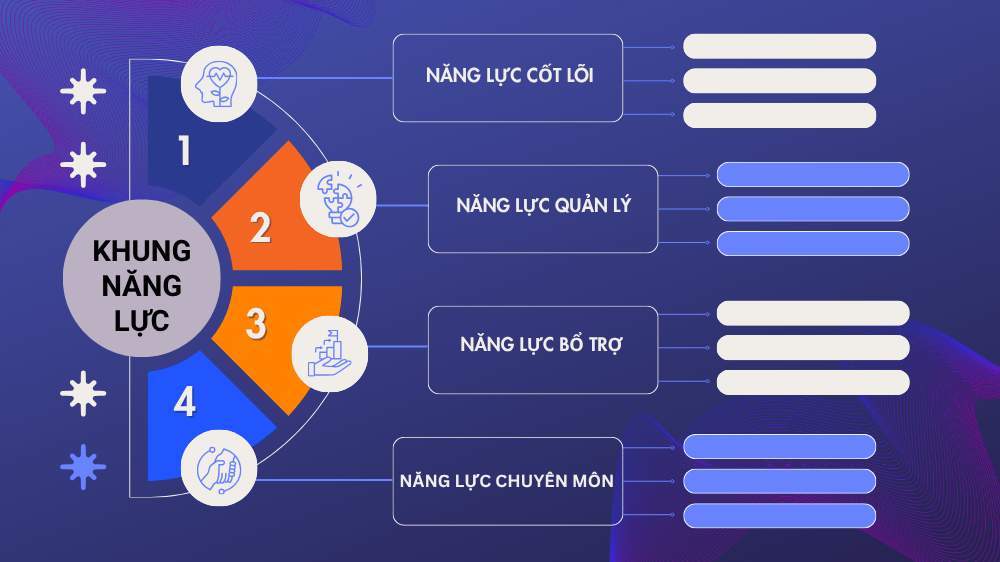
According to international standards (SHRM, CIPD, Korn Ferry) and Vietnamese business practices, an effective competency dictionary should be designed according to 4 main groups:
| Competency group | Characteristics | Scope of application |
|---|---|---|
| 1. Core Competencies | It reflects the core values, culture, and behaviors of the business. | All employees. |
| 2. Leadership/Management Skills | The ability to guide, lead, train, and inspire. | Management level. |
| 3. Professional competence | Knowledge, professional skills, and technical expertise required for each position. | By department/specific job. |
| 4. Supporting skills / work context | The ability to adapt, improvise, and handle specific situations in a changing environment. | Depending on the context, role, market, and customer. |
Each competency is described using the following structure:
-
Definition of competence – Briefly describe the nature of the ability.
-
Observable behavior – Describe specific actions that demonstrate competence.
-
Level of proficiency – indicates the level of competence achieved.
Illustration:
| Ability name | Define | Level of behavior |
|---|---|---|
| Spirit of cooperation | The ability to work with others to achieve common goals. | 1: Join the team → 3: Support teammates → 5: Lead a culture of cooperation. |
3. How to build a competency dictionary
Businesses can choose between using different sets. A dictionary of available competencies is available. and adapt to the specifics of the business or self-built Through internal data and expert analysis.
Reality, There is no such thing as an "absolutely perfect" set of books.but there is Several internationally recognized standards can be customized for businesses..
Here are some sample frameworks to consider:
| Framework / Organization | Outstanding characteristics | Suitable for whom? |
|---|---|---|
| SHRM Competency Model (USA) | Nine core human resource competencies, designed based on behavior. | The company has a professional HR system. |
| CIPD Profession Map (English) | Focus on human resource professional competencies, which can be extended to other industries. | European companies, FDI organizations, or educational institutions. |
| Korn Ferry Leadership Architect / Lominger | The Deep Behavioral Competency System comprises 38 standardized competencies and 4 levels. | Large-scale, leadership-oriented business. |
| Mercer Competency Framework | Directly linked to 3P compensation and performance evaluation. | SMEs and FDI in Asia: Easy to apply and customize. |
| OECD Core Competency Framework | The framework for public service conduct competencies is logical and adaptable. | Service businesses, non-profit organizations. |
Expert's perspective: Which approach should SMEs choose?
For SMEs, the Building a dictionary from scratch is unnecessary and expensive.The most practical approach is:
-
Choose a suitable international template set.
-
Refine 20–30 key competenciesEliminate capabilities that are not a good fit for the company's culture or size.
4. An example of a detailed competency dictionary.
1
Core competency group
Applicable to all employees – reflecting core values, culture, and behaviors.
|
Ability name |
Define |
Illustrative behavior |
Level of proficiency |
|
Spirit of cooperation |
Willing to share information, support colleagues, and collaborate effectively to achieve common goals. |
Listen, respond positively, avoid blaming, and proactively share your experiences. |
1: Join the team → 5: Lead a culture of collaboration. |
|
Integrity |
Act honestly, keep your promises, and respect professional rules and ethics. |
Keep your promises, maintain confidentiality, and speak frankly and truthfully. |
1: Comply → 5: Become a role model of integrity. |
|
Innovation thinking |
Always looking for new and more efficient ways of doing things and processes. |
Propose solutions, measure improvement results, and apply continuous learning. |
1: Implement small improvements → 5: Lead innovation. |
|
Customer orientation |
Understand and meet internal/external customer expectations professionally. |
Put yourself in the customer's shoes and proactively solve their problems. |
1: Understand the needs → 5: Create an outstanding customer experience. |
|
Responsibility for results |
Take responsibility for your actions, results, and personal commitments. |
Always get the job done, don't blame others, and learn from your mistakes. |
1: Complete the task → 5: Establish performance standards for the organization. |
2
Leadership/Management Competency Group
Applicable to leaders, managers, and department heads.
| Ability name | Define | Illustrative behavior | Level of proficiency |
|---|---|---|---|
| Strategic thinking | Identify long-term direction, analyze trends, and make decisions that align with the company's strategy. | Analyze the market, set realistic goals, and create a feasible plan. | 1: Understanding the strategy → 5: Formulating and leading the strategy. |
| Decision making | Make sound decisions based on data, experience, and risk analysis. | Gather information, consider the impact, and act promptly. | 1: Decision support → 5: Strategic decision-making. |
| Team training and development | The ability to guide, provide feedback, and encourage employees to develop their personal skills. | Ask thought-provoking questions and develop employee development plans. | 1: Support colleagues → 5: Build a succession team. |
| Change management | Lead the team in adapting to changes in the organization or market. | Communicating clearly about the reasons helps employees overcome resistance. | 1: Accept change → 5: Lead change across the entire organization. |
| Influence and inspiration | To have a positive influence and shape the behavior and attitudes of others. | Communicate a clear vision, encourage commitment, and foster engagement. | 1: Effective communication → 5: Inspiring the organization. |
3
Supplementary competency group / context
Reflects the ability to adapt, interact, and create value in specific environments.
This group is the "catalyst" that creates it. Performance differences between people in the same position.
|
Ability name |
Define |
Example of behavior |
Application |
|
Multicultural understanding |
The ability to work effectively with people from different cultural backgrounds. |
Respect differences and adjust your communication style accordingly. |
For personnel responsible for FDI clients/partners. |
|
Specific customer mindset |
Understand and respond appropriately to the characteristics of specific customer groups (e.g., female entrepreneurs, high-end customers, SMEs, etc.). |
Understanding behavior, being tactful in communication, and adjusting service style are key. |
For Sales, Customer Service, and Marketing. |
|
Adaptation & situation handling |
Responding quickly, flexibly, and effectively to unexpected situations. |
Stay calm, make quick decisions, and balance the risks. |
For frontline workers and operations managers. |
|
Informal influence |
They exerted a positive influence despite lacking official power. |
Build trust, encourage teamwork, and spread a positive attitude. |
For key employees and internal mentors. |
|
Adaptive innovation |
Applying new ideas that are relevant to reality, and continuously improving based on market feedback. |
Experiment, learn quickly, adapt flexibly. |
For Marketing, Product, and R&D teams. |
4
Professional competency group
This applies to each department and specific job role.
Below is an example of a general framework that can be customized according to each function:
|
Ability name |
Outstanding Department |
Define |
Proficiency levels (1–5) |
|
Data analysis & reporting |
Accounting, finance, human resources. |
Collecting, processing, and interpreting data to support decision-making. |
1: Understanding the data → 5: Analyzing strategies. |
|
Legal understanding and compliance |
Accounting, human resources, legal affairs. |
Understand and comply with legal regulations and industry standards. |
1: Knowing the regulations → 5: Managing compliance risks. |
|
Professional customer service |
Business operations and customer service. |
Meet and exceed customer expectations through professional service. |
1: Resolving requests → 5: Providing high-value advice. |
|
Manage projects |
IT, Marketing, Operations. |
Planning, coordinating resources, and monitoring progress and results. |
1: Participate in the project → 5: Lead a complex project. |
|
Technology applications |
The entire enterprise. |
Proficient in using technology and software for work purposes. |
1: Know how to use → 5: Optimize and innovate using technology. |
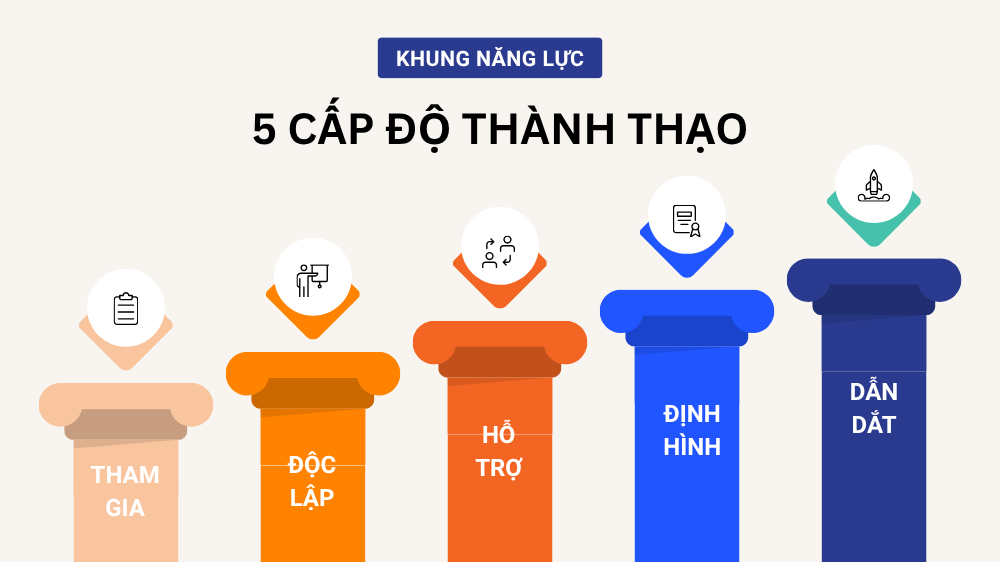
5. Level system in the competency framework
| Level | Explain | Commonly applied ranks |
|---|---|---|
| 1 – Basic (Participation) | Understand the concept and be able to perform the task with guidance. | Trainee, new. |
| 2 – Proficient (Independent) | Perform routine tasks independently. | Standard. |
| 3 – Knowledge (Support) | Proficient in most situations, assisting others. | Team leader. |
| 4 – Specialization (Shaping) | Handling complex situations, optimizing processes. | Department head, section head. |
| 5 – Expert (Leader) | Establishing standards, providing training, and setting strategic direction. | Senior leaders. |
Conclusion
A competency dictionary is more than just a human resources document – it is strategic language This helps businesses transform their people into a sustainable competitive advantage. When every decision, from recruitment and training to performance evaluation and compensation, revolves around a unified set of standards, organizations not only minimize risk but also multiply value from their workforce.