
Prologue
In the context of a rapidly changing business environment, Vietnamese businesses – especially small and medium-sized enterprises (SMEs) – are facing challenges between efficiency, compliance, and sustainable development.
Technological advancements, changes in labor behavior, and the pressures of international integration have rendered traditional human resource models inadequate.
Based on that assessment, EXPERTIS HR 5Ps Sustainable Profit Door Design developed as a strategic human resource management model helping businesses establish An integrated human resources system that prioritizes compliance, efficiency, and sustainable development..
Context

In the current environment, businesses must operate under the simultaneous influence of multiple factors:
- Economic volatility and highly competitive markets It requires the ability to optimize resources.
- Shifts in the labor market and generational changes in the workforce. (Gen Y, Gen Z, Gen G) demand that businesses build a management model that is people-centered, not just based on salaries and bonuses.
- The legal framework, with its increasingly substantive regulations and ever-higher application standards, is becoming more comprehensive.This requires businesses to ensure compliance in all their human resources activities.
- The development of technology and artificial intelligence.This creates pressure for innovation.
In light of these factors, EXPERTIS has developed a strategic human resources model. HR 5Ps Sustainable Profit as a comprehensive solution to help businesses:
- Establish strategic human resource thinking.
- Develop a human resource management system in the following direction: measurable, directly linked to business objectives.
- Maintain The balance between compliance, efficiency, and sustainable development..
This model aims to help managers. understand correctly and do it correctly. in human resource management – from which it is formed Sustainable profitability based on organizational capabilities..
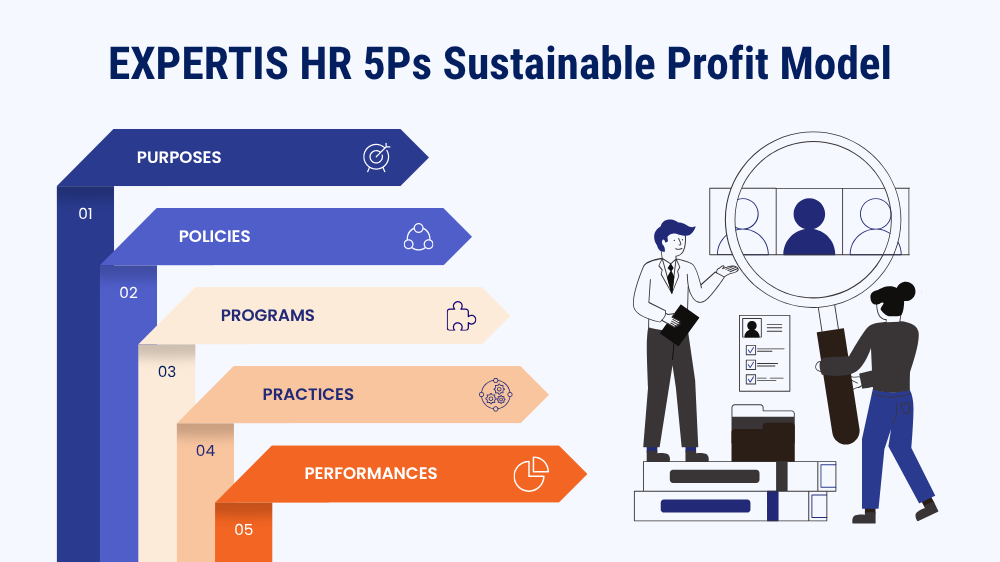
EXPERTIS HR 5Ps Strategic Human Resources Model - Sustainable Profit Model
As the name suggests, this human resources model is based on five core aspects: Purpose (purposes) – Policy (Policies) - Programme (Programs) - Practice (Practices) - Efficiency (Performance ).
1
OBJECTIVES (PURPOSES)
In the strategic human resources model EXPERTIS HR 5Ps Sustainable Profit, Purposes This is the highest strategic orientation level, defining the core scope and objectives of the entire human resources system within the enterprise.
Content:
(1) Establishing human resource orientation linked to business strategyThis ensures that human resources are developed and utilized as a strategic asset, not just an expense.
(2) Creating a sustainable value framework For human resource decision-making, this includes: respect, fairness, equality, and adherence to the law. It creates an environment where each individual can develop their potential, connect with others, and contribute to the overall outcome.
(3) Performance: Effective management the relationship between people, organizations, and profit, sustainable development.
(4) Adapt to change: Human resource systems must be flexible enough to respond to changes in technology, markets, and the labor environment.
2
POLICIES
Policies are guidelines that serve as a foundation for achieving desired goals and outcomes. They are established to provide direction, set standards, and promote consistency throughout an organization or process.
By providing a set of rules and expectations, principles help ensure that decisions are made consistently, effectively, and in compliance.
Content:
Model EXPERTIS HR 5Ps Sustainable Profit It comprises four core policy groups:
(1) Compliance policy and legal obligations
Ensure all activities related to people are carried out in accordance with the law, including: Labor – Social Insurance – Health Insurance – Unemployment Insurance (SHUI) – Personal Income Tax – Corporate Income Tax.
This set of policies helps businesses. Legal risk preventionMaintaining transparency and protecting the legitimate rights of both parties in labor relations.
(2) Organizational and cultural policy
Define the standards of conduct, core values, and ethical principles within the organization.
This policy group lays the groundwork for a professional, respectful, and collaborative work environmentwhile maintaining a cultural identity that aligns with the company's development direction.
(3) Development and performance policy
This regulation establishes principles for managing, evaluating, and recognizing employee performance, ensuring fairness and incentives within the human resources system.
This policy group sets the framework for the implementation of Reward program, performance evaluation and improvement, aiming to optimize organizational productivity.
(4) Human resource investment policy
Human resource investment policies define the direction and limits on the use of financial resources for human development activities, including: training, capacity building, equipping with work tools, improving the work environment, and employee engagement programs.
3
PROGRAMS
In the model EXPERTIS HR 5Ps Sustainable Profit, Programs It is understood as a set of systematically implemented human resource measures, plans, and activities aimed at Implement Policies , and Achieve the Purposes of the organization.
The program is strategic deployment levelwhere policy principles are translated into structured, targeted, and measurable actions.
Content:
The model identifies five key human resource program groups, considered core components in sustainable profit-oriented organizational management:
(1) Program for building and developing a competency framework
Establishing a competency framework serves as the foundation for all human resource activities. This program defines competency standards for each position, forming the basis for recruitment, training, performance evaluation, and career development.
(2) Recruitment, selection and program and retain employees
Focus on attracting, screening, and retaining the right talent to meet the organization's needs.
This program ensures resource continuity, maintains a rational staffing structure, reduces personnel replacement costs, and minimizes operational risks.
(3) Reward, incentive and recognition program
Designed to provide a direct link between hiệu suất làm việc , and compensation policy, ensuring fairness and encouraging employee contributions.
Elements of this program may include: regular rewards, recognition of achievements, performance-based reward mechanisms, and non-financial incentives.
(4) Training and capacity building program
The aim is to enhance the professional skills, abilities, and management capabilities of employees, in order to support the organization's development strategy.
The program includes internal training, external training, on-the-job training, and succession planning.
Each training program must have clearly defined objectives, content, duration, cost, and methods for evaluating effectiveness (ROI or equivalent criteria).
(5) Performance management and evaluation program
Designed to ensure transparency, objectivity, and a systematic approach to measuring the performance of individuals, teams, and the entire organization.
4
PRACTICES
In the model EXPERTIS HR 5Ps Sustainable Profit, Practices is the layer that represents operationalizing the Programs through specific activities, processes, and behaviors in the practice of human resource management.
If Policy define the rules, Program If the organization takes action, then... Practice is the stage realization – where people, processes, and tools are connected to produce tangible results.
Practice is the key element. level of operational maturity of the organization, reflecting the alignment between strategy and reality, between direction and action.
Content:
The practice is divided into basic activity groups, corresponding to the key functional areas of human resource management:
(1) Recruitment and integration practices
This includes recruitment, interviewing, contract signing, and onboarding of new employees.
The goal is to help employees understand the organization's culture, processes, and their roles from day one, laying the foundation for long-term engagement.
(2) Training and development practice
Focus on implementing internal training programs and developing capabilities based on the established competency framework.
This includes on-the-job training, professional development, soft skills development, succession programs, and mentoring.
This activity ensures continuity in enhancing the organization's capacity and adaptability.
(3) Practice bonding in work environment and build organizational culture
This includes activities to maintain morale, foster team cohesion, and develop organizational culture.
The main contents include: internal communication, recognition of contributions, team activities, and developing a positive work environment.
Ensuring a safe working environment, fair benefits policies, and activities that support physical and mental health.
The goal is Retain talent through experience and perceived value..
(4) Performance management practices and results recording
Implement performance evaluation tools and processes based on KPIs, OKRs, or competency standards; provide regular feedback; and recognize individual and team achievements.
Data from this activity forms the basis for rewards, promotions, and career development planning.
(5) Practice of labor relations and wage management
Perform tasks related to timekeeping, payroll, insurance contributions, income tax, personnel record management, and other legal obligations.
The goal is to ensure accuracy, transparency, and compliance, while maintaining trust between employers and employees.
(6) Practice termination and handover
This includes activities related to contract termination, job handover, exit interviews, settlement of accounts, and post-termination feedback.
This practice helps maintain a professional image, ensures legal compliance, and facilitates the maintenance of positive relationships with former employees.
5
PERFORMANCE
In the model EXPERTIS HR 5Ps Sustainable Profit, Performance This is the final layer, representing the overall result of the entire personnel deployment process. Objectives – Policies – Programs – Practices.
Performance is not just measured. results of individual and organizational work, but also reflects the level of effectiveness of the entire human resources system in contributing to sustainable profitability..
This is the floor evaluation, feedback, and adjustments The model ensures that all HR activities create tangible and data-driven value.
Content:
Performance Layer includes four main evaluation groups, reflecting the relationship between people – processes – results – finances:
(1) Measuring individual performance
Evaluate individual performance based on job criteria, KPI/OKR objectives, or competency standards.
The results serve as the basis for rewards, promotions, training, and position adjustments.
(2) Measuring organizational performance
This reflects the level of achievement of departmental and overall enterprise objectives, including metrics on productivity, quality, cost, time, and compliance.
This result helps determine the operational efficiency and management capabilities of the human resource management system.
(3) Human Resource Performance Indicators
Focus on evaluating the performance of the human resources system. Some typical metrics include:
- Employee turnover rate, key employee retention rate.
- Training and capacity building completion rates.
- Personnel costs compared to revenue.
- Employee satisfaction and engagement levels.
- Level of compliance with legal regulations and personnel data.
(4) Measuring the effectiveness of human resource finance
Reflecting the financial impact of human resource activities on business results. This includes analyzing the correlation between human resource costs and value created, for example:
- The effectiveness of investment in training and development.
- Value added per employee.
- The impact of employee engagement on productivity and revenue.
Efficiency leaves convergence and feedback points of the entire model EXPERTIS HR 5Ps Sustainable ProfitIt not only reflects the effectiveness of the human resources system, but also... Strategy verification and adjustment mechanism, ensuring that all activities involving people contribute directly to sustainable profit objectives.
Performance in this model is therefore not just about the result, but about... intelligent data feedback systemThis helps businesses maintain competitiveness and achieve continuous growth in a volatile environment.

Conclusion
Model EXPERTIS HR 5Ps Sustainable Profit It is not just a theoretical framework for human resources, but practical thinking system Helping businesses realize their sustainable development goals through their people.
By implementing all five layers simultaneously: Purpose – Policy – Program – Practice – PerformanceThis model helps organizations control risks, improve operational efficiency, and transform human resource activities into... Sources of measurable value.
It's not just a management model, EXPERTIS HR 5Ps Sustainable Profit Is one systems thinking framework, helping businesses manage people as part of the structure of sustainable profitability – where strategy, compliance and organizational capacity Balanced and optimized within the same operating system.