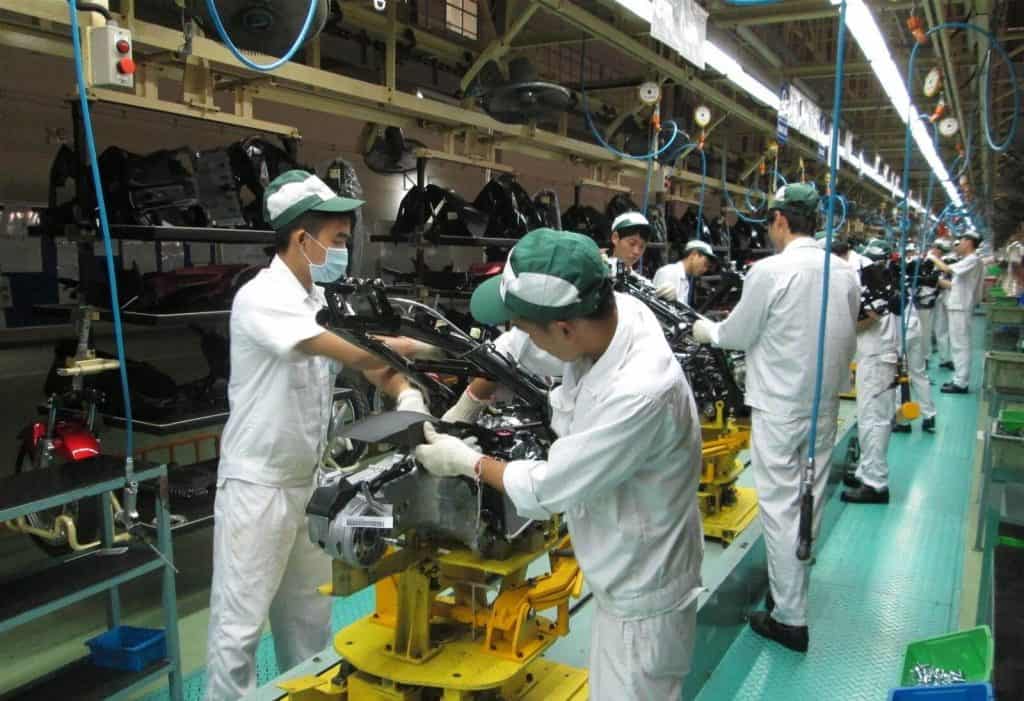
The draft strategy, considered a new generation strategy for attracting foreign direct investment (FDI) developed by the Ministry of Planning and Investment in collaboration with the World Bank (WB), is attracting attention from experts and businesses both domestically and internationally.
The objective of the Strategy is to identify sectors and fields, review the policy framework for attracting FDI, and propose specific solutions and policies to help Vietnam boost FDI attraction into these priority areas.
1. Maximize the spillover effect to attract FDI.
According to Mr. Do Van Su, Head of the Foreign Investment Department, Investment Agency (Ministry of Planning and Investment), as of April 2018, a total registered capital of US$321,25 billion had attracted more than 25.000 FDI projects in Vietnam. Of this, approximately US$177,47 billion had been disbursed, equivalent to 55,2% of the total registered capital in effect. This figure shows that Vietnam has achieved exceptionally good results in attracting FDI. Annual FDI flows have increased by nearly 1.000% over the past 10 years.
In 2017, FDI inflows into Vietnam ranked second in ASEAN, after Singapore. In terms of GDP per capita, Vietnam surpassed China, India, and other major ASEAN countries. Furthermore, FDI enterprises have expanded geographically to 51 provinces and cities. FDI enterprises currently account for 70% of export turnover, 55% of industrial production output, 18% of tax revenue, and have created over 3,7 million jobs. Coupled with an open-door policy, this has created momentum for integration with the global economy, participation in regional production networks, and diversification of exports.
Mr. Nguyen Huu Nam, Head of the Legal Department (Vietnam Chamber of Commerce and Industry, Ho Chi Minh City Branch), stated that the FDI sector currently contributes approximately 25% of total investment capital to society and 20% of the country's GDP.
However, after 30 years, attracting FDI also has some limitations and risks, as seen in certain cases.:
- Outdated technology is negatively impacting the regional environment.
- Law enforcement and sanctions at some FDI enterprises have not been strictly enforced.
- There is transfer pricing activity.
- Commercial fraud
In particular, businesses entering Vietnam mainly engage in processing and assembly, utilizing cheap labor and taking advantage of incentives without increasing added value…
2. Growth phase
In that context, the Draft Strategy and Orientation Attracting FDI capital continues to flow into Vietnam. The period from 2018 to 2030 is considered a key period, a shift in the focus of products in Vietnam, creating conditions for the types of investment that Vietnam will need in the future, aiming to maximize the spillover effects and added value of FDI in the near future.
The goal of attracting new-generation investments is to focus on high-tech activities, the automotive and motorcycle industries, and supporting industries (minerals, chemicals, metal production, high-grade plastics and high-tech components), industrial equipment, logistics, new high-value agricultural products, environmental technology, renewable energy, etc., in order to create a large number of jobs and narrow the economic development gap between provinces and cities nationwide.
The most noteworthy new feature:
- Introducing the business environment in the era of Industry 4.0, commensurate with the needs of investors in the digital age.
- Review the entire current investment incentive policy framework.
- Re-establish a balance between profit-based incentive policies and performance-based incentive policies.
Accordingly, the regulations on incentives will be transferred from the Investment Law to the Tax Law and the Customs Law, with the assistance of an effective monitoring and evaluation system. Key service sectors will be opened up to provide a foundation for competitiveness and growth for foreign investment…www.expertis.vn